
Why Bonds and Stocks Just Cast Opposite Votes on the Fed's First Hike Since 2023
★ ELITE MARKET POINT
Market Intelligence That Moves With You
Fed Fallout • Weekend Briefing
The 10-Year Hit 5%. The Nasdaq Rose Anyway.
The Fed’s first hike since 2023 split the market down the middle. Bonds priced 2007. Tech priced a boom. Here is how to be positioned for the tiebreaker.
Sunday, September 21. Futures reopen tomorrow night with the 10-year at 5%, crude above $100, and the Fed’s inflation number nine days out.
Key Idea
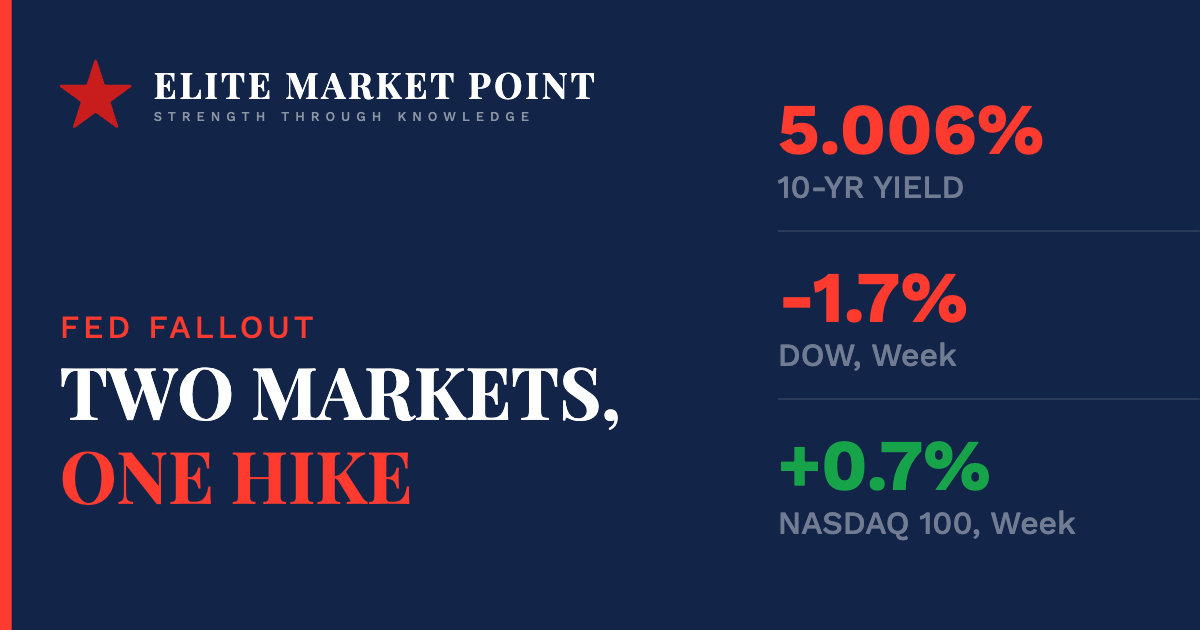
The Federal Reserve raised rates Wednesday for the first time since 2023. The bond market and the stock market read it in opposite directions. The 10-year Treasury yield closed Friday at 5.006%. That is the highest since July 2007. The Nasdaq 100 still finished the week green. One of those two markets is wrong. PCE on September 30 tells you which. That is the inflation number the Fed watches above all others.
ACTION TAKERS WANTED: Big Elon Opportunity
Elon’s new venture is bigger than Tesla, bigger than SpaceX… bigger than both combined.
Based on a hushed FCC filing James Altucher just uncovered, he believes Elon’s next project will create 1,806,000 new millionaires over the next decade starting September 25.
Almost nobody knows what it is yet, but action-takers who follow the briefing James put together can get first-dibs on the $100 stock at the center of it all.
The Week In Two Ballots
Fed Chair Kevin Warsh took the podium Wednesday. He did not soften a word. The Fed lifted its benchmark rate to 3.75% to 4.00%. First hike since 2023. The vote was unanimous. Its own projections still pencil in one more hike this year.
Then the bond market went to work. The 10-year Treasury yield touched its highest level since July 2007. It closed Friday at 5.006%. That is the rate that sets your mortgage, your car loan, and the price of every share you own. Crude held above $100. WTI, the U.S. oil benchmark, settled at $100.30. The Dow lost 1.7% on the week. Its worst week since March.
Here is where it gets interesting. The Nasdaq 100, the exchange’s 100 largest nonfinancial companies, rose 0.7% in the same five sessions. Read that again. Bonds priced a hotter, higher-for-longer world. Tech priced a boom. Both cannot be right.
Watch the 10-year, not the headline index. If it holds above 5%, the pressure stays on your rate-sensitive holdings.
Why The Two Markets Split
The split is not noise. It is two clocks running at different speeds.
Bond traders answer to inflation and the Fed. Consumer sentiment printed 47.8 in the preliminary September survey. That is the second-lowest reading on record. Inflation expectations rose. Warsh looked at that and hiked anyway. Bonds believe him.
Equity buyers answer to earnings. And the biggest names on the Nasdaq fund their own growth. Nvidia, the chipmaker at the center of the AI buildout, does not need borrowed money to spend. Neither does Microsoft, the cloud-software giant. So the rate that crushes a homebuilder barely dents them.
That is the whole market in one sentence. The companies that need borrowed money are bleeding. The companies that print their own are not. Own the second group. Rent the first.
Personal Flight
Air-Taxi Companies Are Building for Riders. Doroni Is Building for Owners.
Joby and Archer are building commercial air-taxi networks around operator-run fleets, passenger routes, and vertiport infrastructure.
Doroni is targeting a different part of the same market. It is developing the H1-X as a personal aircraft for sale directly to individual owners.
Morgan Stanley estimates that the urban air mobility market could reach $1 trillion by 2040. Doroni is building for the personal-ownership side of that opportunity.
Shares in the current Regulation A round are available at $3.30.
The Number Behind The Split
Here is the comparison nobody is making. A 5% risk-free rate is not just a bond story. It is the hurdle every other asset now has to clear. That is what a ‘risk-free rate’ means: the return you earn for taking no risk at all. When cash and Treasuries pay 5%, a stock has to promise more than 5% to be worth owning. The Dow’s dividend names cleared that bar for years on yield alone. At 5%, they no longer do. That one reset explains the entire week. The Dow bled. The self-funding tech names held. Gold closed higher for the first time in four weeks. The next print that moves the risk-free rate is PCE, and it lands September 30.
Three Ways This Breaks
Base
Yields hold near 5% and the tape stays choppy into month-end. Favor companies that fund themselves: Nvidia (NVDA), Microsoft (MSFT), and cash-rich mega-cap tech. Keep energy for the $100 oil backdrop: Exxon (XOM) and the XLE energy fund. Park idle cash in short-term Treasuries paying near 5% while you wait. Micron (MU), the memory-chip maker, reports September 30 and sets the tone for the group.
Upside
PCE cools on September 30 and the 10-year slips back under 5%. That is the release valve. Growth re-rates fast: the Nasdaq 100 (QQQ) and semiconductors (SMH) lead. Beaten-down rate-sensitive names bounce hardest, including homebuilders (XHB) and regional banks (KRE). A soft inflation print plus a strong Micron guide hands you a two-day window. Position before the number, not after.
Risk
PCE runs hot and the 10-year pushes past 5.1%. This is not a summer scare. It is the first hike since 2023, and Warsh told you more may come. Expect a 3% to 5% pullback in the S&P 500 over the following week. Long-duration tech and long Treasuries (TLT) fall furthest. Hedge with short-duration bonds, energy, and any gold (GLD) you already hold. Do not buy the first red candle.
Our View
We flagged the 30-year through 5% back in June as the number that would outrank any earnings beat. Friday the 10-year joined it at 5.006%. Now the new read. The market spent this week arguing with itself, and neither side won. The verdict is not due until September 30, when PCE and Micron land inside the same 48 hours. One is the macro tiebreaker. The other is the AI bellwether. Between now and then, you do not have to pick a side. You have to be positioned for both: self-funding quality on one end, a short-duration cash cushion on the other. The barbell is the trade. Friday’s final sentiment read at 10 AM is your first tell. Watch it.