
What Columbus Day Hides About the Record

What Columbus Day Hides About the Record
For one session the 10-year can’t move. Tuesday the banks turn that yield into a verdict.  ‌ ‌ ‌ ‌ ‌ ‌ ‌ ‌ ‌ ‌ ‌ ‌ ‌ ‌ ‌ ‌
★ ELITE MARKET POINT
Market Intelligence That Moves With You
Earnings Week
Seven Points From a Record. The Day Bonds Can’t Vote.
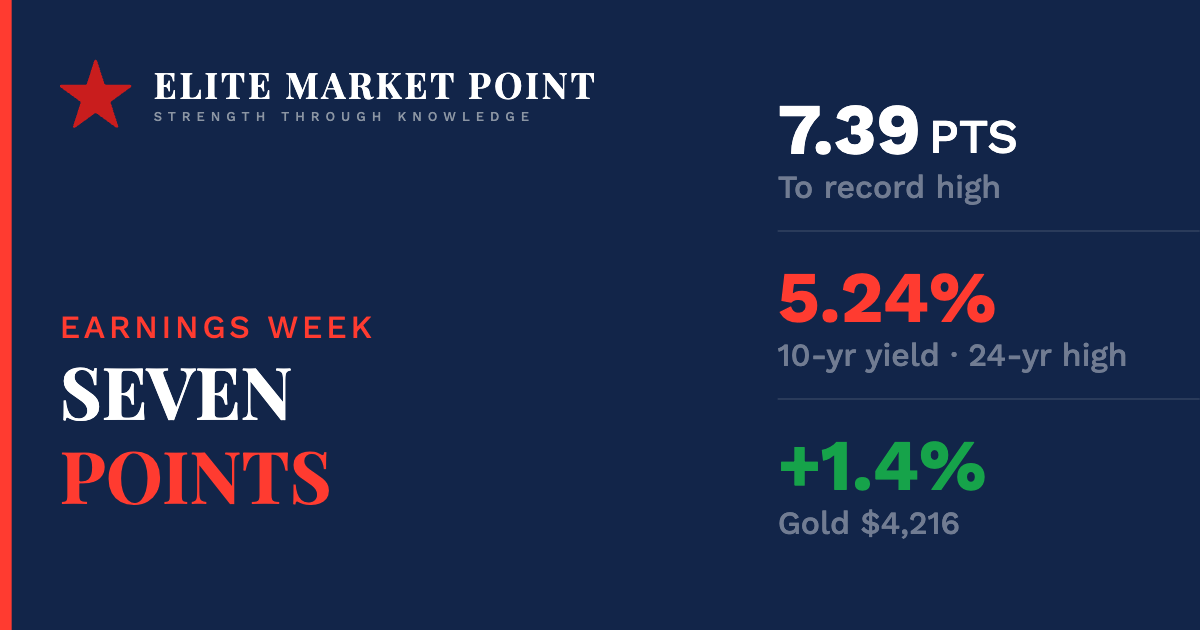
The S&P closed Friday at 7,811.54. The record is 7,818.93. Between them sits a 24-year high in yields. Today, for one session, the bond market is shut.
Columbus Day means stocks trade and bonds don’t. Tuesday, both reopen with the banks. Here’s the window and the wall.
Key Idea
One number has capped this market all week. The 10-year Treasury yield. That’s the interest the government pays to borrow for a decade, and it prices every mortgage and every stock multiple in the country. It just hit 5.24%. A 24-year high. Every time it ticked up, stocks sold off. Today the bond market is closed for Columbus Day, so that number can’t print. Stocks trade alone, seven points from a record, with nothing pushing back. Read that again. The ceiling took the day off.
The whole case, in six numbers

$1.15 per share

$1M → $26M revenue in four years

45 farms, 10M+ trees

3,000+ retail locations across 21 states

2,000+ investors already in

Up to 20% bonus shares

One private coffee company. Colombia’s largest producer. You can read the full offering in about the time it takes to finish your cup.

Get the rest of the numbers →

Private investments are speculative and illiquid. Returns are not guaranteed. Review the offering circular before investing. Under Regulation A, a company may change its share price by up to 20% without requalifying the offering with the Securities and Exchange Commission.

Where Friday Left You
Friday closed green across the board. The Dow added 423 points to 51,654. The S&P gained 0.59% to 7,811.54. The Nasdaq rose 0.64% to 27,366.

Look at the week behind it. It was volatile for one reason. The 10-year yield climbed toward a 24-year high and dragged stocks down with it. Friday it eased a touch. Stocks bounced. That is not a coincidence. That is the whole story of October: as the 10-year goes, so goes your portfolio.

The S&P now sits 7.39 points under its October 6 record of 7,818.93. One good session clears it.
Why Today Is Different
The stock market is open today. The bond market is not. SIFMA calls a full close for Columbus Day. That’s the trade group that sets the Treasury market’s calendar. The banks are shut too.

So the 10-year yield, the number that built the ceiling all week, gets no print today. There is no bond tape to fight. For one session the wall that capped every rally simply isn’t there. Think about that. The market gets to test the record without the one variable that keeps beating it back.

Volume runs light on a holiday. Fine. The VIX closed at 14.84, its calmest in weeks. That’s the market’s fear gauge. Quiet tape, no bond resistance, record in reach.

Watch the 7,818.93 line. If the S&P takes it today, it did it on a day bonds couldn’t object.
Tuesday Is The Verdict
Tomorrow everything reopens at once. The 10-year print returns at 8 a.m. And before the bell, four of the biggest banks report. JPMorgan, Goldman Sachs, Citigroup, and Wells Fargo. Bank of America and Morgan Stanley follow Wednesday.

Here’s where it gets interesting. The same 5.24% yield that has been crushing stocks is what pays the banks. When the 10-year rises, a bank earns more on every loan it holds. That spread is net interest income. It’s the gap between what a bank collects on loans and pays out on deposits. The yield that threatens your index fund is a tailwind for your bank stock. That is not a contradiction. That is the asymmetry. Wall Street expects roughly 20% profit growth from the group.

Earnings week also sends the crowd hunting single names. A few analysts are now touting what one of them calls Elon Musk’s One Stock Retirement Plan. Not Tesla or SpaceX.

Then Wednesday, the Consumer Price Index lands. That’s the government’s main gauge of what you pay at the store. Consensus sits near 3.7%. A hot print sends the 10-year higher the second bonds reopen, and the window slams shut.
The Board As Bonds Go Dark
7,811.54
S&P 500 • 7.39 pts from record
5.24%
10-Year Yield • 24-year high
$4,216
Gold • +1.4% Friday
14.84
VIX • calmest in weeks

Most people missed it. But if you go back and listen carefully, there’s a pattern.

Trump didn’t just mention gold once. He’s dropped a series of sly hints that, when you line them up, paint a very clear picture.

He promised a “new American Golden Age.” Most people took that as a slogan. What if it wasn’t?

He warned that to fix the economy “there would be some pain.” Most people assumed he meant tariffs. What if he meant something bigger?

His Treasury Secretary went on national television and said the administration plans to “monetize the assets on the balance sheet.” The government’s single biggest asset? 261 million ounces of gold valued at $42 an ounce on the books. Worth over $1.2 trillion at market prices.

There’s legislation in his own party right now to revalue that gold. A Federal Reserve economist published a paper on how to do it. And central banks around the world are hoarding gold like they already know the ending.

One hint is a comment. Two is a coincidence. This many is a plan.

No president since Nixon has talked about gold this openly. And the last time a president acted on gold, FDR in 1934, it created one of the biggest wealth events of the century. Most Americans had no idea until it was too late.

A free report called “The Great Gold Reset” connects every hint, every statement, every piece of legislation into one clear picture. And shows you how to get on the right side of it in about 15 minutes. No taxes. No penalties.

Download Your Free Report Here →

The Yield Wears Two Hats
Most readers see the 10-year at a 24-year high as pure bad news. Higher mortgage. Lower stock multiple. A cheaper bond than the one you already own. All true. But the banks sit on the other side of that trade. They lend at the high rate and pay depositors almost nothing. The yield that thins your retirement statement fattens their margin. So this week asks one question in two voices. Can the economy carry a 5.24% 10-year? Stocks call it a threat. The banks, on Tuesday, get to call it a paycheck.
Three Ways This Week Breaks
Base
Light-volume drift. The S&P flirts with 7,818.93 but doesn’t decisively clear it on a holiday tape. The banks set the real tone Tuesday. Hold SPY, the S&P 500 fund. Hold your bank names. No new risk added today.
Upside
Stocks break the record today with no bond resistance. Then JPMorgan and Goldman beat Tuesday on net interest income and trading. Add to JPM, BAC, and GS. XLF, the financial-sector fund, leads the next leg. The 10-year holds near 5.2% and the multiple survives.
Risk
Wednesday’s CPI runs hot, above 3.7%. The 10-year gaps toward 5.4% the instant bonds reopen. The record gets sold. Long-duration tech takes the hit. Trim the most rate-sensitive growth, and watch TLT, the long-term Treasury fund, for the damage.
Our View
We told you in October the 10-year was the only variable that mattered. It still is. Today it goes quiet, and that changes the read. Don’t confuse a record set on a closed-bond holiday with a market that has beaten the yield. It hasn’t. It got a day off. The real test is Tuesday at the open, when bonds vote and the banks answer. Our position: own the barbell. Hold your quality banks into earnings for the net-interest tailwind. JPMorgan and Bank of America lead it. Keep rate-sensitive growth on a short leash until the 10-year proves it can hold under 5.3%. And watch the gold line. At $4,216 it’s telling you people still want insurance. When the bond market reopens tomorrow, you’ll learn whether this record was real or rented.