
The Economy Is Booming. The Consumer Is Cracking. Bitcoin Surged 22%. The President Claimed Hormuz. Welcome to the Two-Speed Economy.
★ ELITE MARKET POINT
Market Intelligence That Moves With You
WEEKEND BRIEFING
The Economy Is Booming. The Consumer Is Cracking. Bitcoin Surged 22%. The President Claimed Hormuz. This Is the Two-Speed Economy.
Flash PMIs hit a 52-month high on Friday. Walmart fell 9% on Thursday. Bitcoin posted its best week since 2023. The 30-year yield ended higher than where it started despite Bessent’s intervention. And Trump declared the Strait of Hormuz “American territory” at a Friday rally. Next week: Nvidia Tuesday. Jackson Hole Wednesday.
Saturday, August 22, 2026 • S&P 500 (Fri close): 7,674.37 • 30-Year Yield: 5.27% • BTC: $78,335 • Brent: $93.80
Key Idea
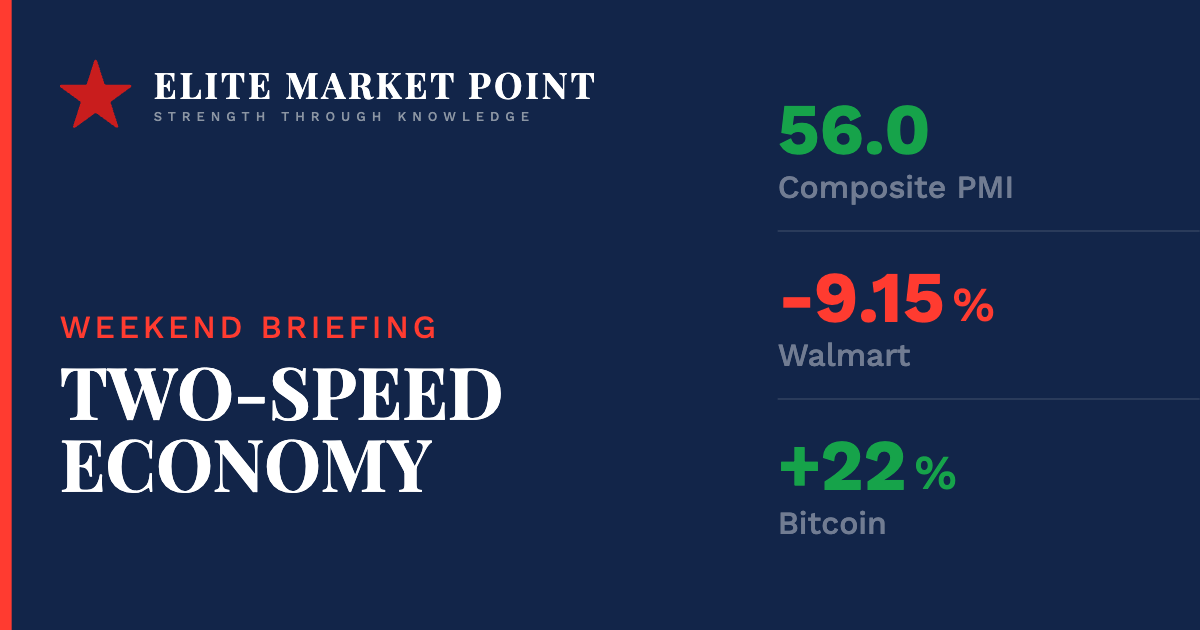
On Friday, S&P Global reported that US business activity hit its fastest pace since April 2022. The composite PMI surged to 56.0, a 52-month high. Services jumped to 56.8. Employment grew at the fastest rate since early 2025. Chief economist Chris Williamson said “US business is booming.” On Thursday, Walmart fell 9% after reporting its slowest comp growth since 2020. On Monday, consumer sentiment sat at 51, the 2nd percentile in survey history. The economy is booming and the consumer is cracking at the same time. That is not a contradiction. It is a two-speed economy. And next week, Nvidia and Jackson Hole will tell you which speed matters more.
Our Partners
For the last 78 years, one thing has predicted a bull market…
With 100% accuracy…
The midterm election.
It doesn’t matter which party wins.
Or what the economic conditions are.
In war and in peace…
The 12 months following a midterm election are the most profitable.
This midterm will be no different.
And I just caught Wall Street sneaking money into two stocks — ahead of the Nov. 3 election.
With 100% accuracy…
The midterm election.
It doesn’t matter which party wins.
Or what the economic conditions are.
In war and in peace…
The 12 months following a midterm election are the most profitable.
This midterm will be no different.
And I just caught Wall Street sneaking money into two stocks — ahead of the Nov. 3 election.
THE PMI PARADOX
The flash numbers landed at 9:45 AM Friday and rewrote the narrative for anyone paying attention.
Composite PMI: 56.0 versus 54.0 expected. The highest since April 2022. Services PMI: 56.8 versus 54.0 expected, a 20-month high. Manufacturing PMI: 53.2 versus 53.9 expected, a slight miss but still firmly in expansion for the eleventh consecutive month.
Employment jumped to the highest level since January 2025. Business confidence hit a nine-month high. Input cost inflation moderated to the lowest pace since February, before the war started. Selling price inflation dropped to the slowest since November. Williamson said the data point to annualized GDP growth approaching 3.0% in the third quarter, up from the 1.5% pace in Q2.
Now hold that against what Walmart told you 24 hours earlier. US comps grew 2.6% against the 3.7% expected. Transaction growth fell to 1.5%. Consumers are making “trade-offs.” Michigan sentiment sits at 51. Retail sales fell 0.6% in July.
Both are true. The economy is expanding because the services sector is surging on AI investment, defense spending, and healthcare. The consumer is contracting because gas is $4.08 a gallon, Brent is at $94, and the 30-year yield is pricing mortgage rates above 7.2%. The boardroom is booming. The kitchen table is not. That split defined this week and it will define the rest of the year.
Composite PMI: 56.0 versus 54.0 expected. The highest since April 2022. Services PMI: 56.8 versus 54.0 expected, a 20-month high. Manufacturing PMI: 53.2 versus 53.9 expected, a slight miss but still firmly in expansion for the eleventh consecutive month.
Employment jumped to the highest level since January 2025. Business confidence hit a nine-month high. Input cost inflation moderated to the lowest pace since February, before the war started. Selling price inflation dropped to the slowest since November. Williamson said the data point to annualized GDP growth approaching 3.0% in the third quarter, up from the 1.5% pace in Q2.
Now hold that against what Walmart told you 24 hours earlier. US comps grew 2.6% against the 3.7% expected. Transaction growth fell to 1.5%. Consumers are making “trade-offs.” Michigan sentiment sits at 51. Retail sales fell 0.6% in July.
Both are true. The economy is expanding because the services sector is surging on AI investment, defense spending, and healthcare. The consumer is contracting because gas is $4.08 a gallon, Brent is at $94, and the 30-year yield is pricing mortgage rates above 7.2%. The boardroom is booming. The kitchen table is not. That split defined this week and it will define the rest of the year.
BITCOIN’S BEST WEEK SINCE 2023
Bitcoin surged 22% for the week to $78,335, its strongest weekly gain since March 2023. It touched $79,491 Friday before settling just below $78,000. The move wiped out $3.3 billion in short positions on Wednesday alone. Another $1.25 billion in derivatives were liquidated over Thursday and Friday.
Three catalysts converged. First, Bessent’s buyback announcement on Wednesday weakened the dollar to a three-month low against all G10 currencies. A weaker dollar mechanically lifts Bitcoin for global buyers. Second, Trump urged Congress to pass the Clarity Act, a regulatory framework for digital assets. He met with crypto executives at the White House. Third, spot Bitcoin ETFs recorded $606 million in net inflows on Thursday, the highest since May. BlackRock took 83% of those flows.
The market read it this way. The government is printing, the dollar is falling, the Treasury Secretary is buying back his own bonds, and Washington just signaled it wants crypto regulated rather than banned. That is a liquidity trade. Bitcoin was $63,000 on Monday. It was $78,000 by Friday. That is $15,000 in five days. That is not speculation. That is capital fleeing a system it no longer trusts to store value.
Three catalysts converged. First, Bessent’s buyback announcement on Wednesday weakened the dollar to a three-month low against all G10 currencies. A weaker dollar mechanically lifts Bitcoin for global buyers. Second, Trump urged Congress to pass the Clarity Act, a regulatory framework for digital assets. He met with crypto executives at the White House. Third, spot Bitcoin ETFs recorded $606 million in net inflows on Thursday, the highest since May. BlackRock took 83% of those flows.
The market read it this way. The government is printing, the dollar is falling, the Treasury Secretary is buying back his own bonds, and Washington just signaled it wants crypto regulated rather than banned. That is a liquidity trade. Bitcoin was $63,000 on Monday. It was $78,000 by Friday. That is $15,000 in five days. That is not speculation. That is capital fleeing a system it no longer trusts to store value.
TRUMP CLAIMED HORMUZ. OIL HIT $94.
At a Friday rally in South Carolina, President Trump declared the Strait of Hormuz “American territory.” Earlier in the week he had posted an image on social media showing the strait labeled “New US Territory.” On Wednesday he announced what he called an “Economic D-Day” against Iran: sanctions on any country whose financial institutions, businesses, or government entities provide any lifeline to Tehran.
Iran’s Armed Forces chief of staff responded Friday by warning of a “crushing, regret-inducing and devastating” military response. The UAE suspended all trade with Iran over an alleged missile attack, cutting off Tehran’s last major re-export hub. Brent crude topped $93.80 on Friday, its highest since late July.
The six-month mark of the war approaches next week. Hormuz traffic remains a fraction of its pre-war volume. American gas prices are up nearly a dollar from a year ago. And the administration is simultaneously promising to crush Iran economically and predicting that oil will fall once the conflict ends. Both cannot be true at the same time. But both are being priced simultaneously. That is why Brent is at $94 and the 30-year yield is at 5.27%.
Iran’s Armed Forces chief of staff responded Friday by warning of a “crushing, regret-inducing and devastating” military response. The UAE suspended all trade with Iran over an alleged missile attack, cutting off Tehran’s last major re-export hub. Brent crude topped $93.80 on Friday, its highest since late July.
The six-month mark of the war approaches next week. Hormuz traffic remains a fraction of its pre-war volume. American gas prices are up nearly a dollar from a year ago. And the administration is simultaneously promising to crush Iran economically and predicting that oil will fall once the conflict ends. Both cannot be true at the same time. But both are being priced simultaneously. That is why Brent is at $94 and the 30-year yield is at 5.27%.
NEXT WEEK: THE TWO EVENTS THAT MATTER
Tuesday, August 25: Nvidia (NVDA) reports after the close. Wall Street expects roughly $92 billion in revenue. The stock is the single largest contributor to S&P 500 returns in 2026. If Nvidia beats and holds, the AI boom is intact and the two-speed economy has a growth engine strong enough to carry equities through 5.27% yields. If it beats and sells off, the way Applied Materials, SanDisk, and Walmart all did this week, then the multiple compression trade is real and no company is safe at current valuations.
Wednesday, August 27: Fed Chair Kevin Warsh speaks at Jackson Hole. He has given no forward guidance since taking office. The FOMC minutes showed “several” members wanted to hike. The 30-year yield ended the week higher despite Bessent’s intervention. If Warsh signals concern about the long end of the curve, the market will interpret it as tacit support for Bessent and yields may ease. If he stays focused on inflation, September hike odds climb above 40% and the long bond sells off further.
These two events, 24 hours apart, will determine the direction for the rest of the summer. One is a corporate verdict on AI spending. The other is a policy verdict on yields. Together they will tell you whether the two-speed economy can sustain itself or whether one speed has to break.
Wednesday, August 27: Fed Chair Kevin Warsh speaks at Jackson Hole. He has given no forward guidance since taking office. The FOMC minutes showed “several” members wanted to hike. The 30-year yield ended the week higher despite Bessent’s intervention. If Warsh signals concern about the long end of the curve, the market will interpret it as tacit support for Bessent and yields may ease. If he stays focused on inflation, September hike odds climb above 40% and the long bond sells off further.
These two events, 24 hours apart, will determine the direction for the rest of the summer. One is a corporate verdict on AI spending. The other is a policy verdict on yields. Together they will tell you whether the two-speed economy can sustain itself or whether one speed has to break.
Our View
Six editions. Six days. Here is the scorecard.
Monday we told you the market and the consumer were pricing two different economies. Confirmed. Tuesday we told you the rotation from momentum to durability had begun. Confirmed: HD rose 1% while SOX dropped 5.5%. Wednesday we told you Bessent blinked. Confirmed: yields erased the move within 24 hours. Thursday we told you Walmart would reveal whether the consumer was slowing or rationing. Answer: rationing. Friday we told you the PMIs would determine whether the economy was expanding despite the consumer cracking. Answer: expanding at the fastest pace in over four years.
The two-speed economy is now the consensus. The boardroom is booming. The kitchen table is not. The PMI says 3% GDP growth. Walmart says transaction growth of 1.5%. Both are real. They describe different Americas.
Bitcoin understood this before equities did. A 22% weekly surge tells you capital is looking for an exit from a system where the Treasury buys back its own bonds, the dollar falls to a three-month low, the president claims a foreign waterway as American territory, and the 30-year yield closes the week higher than it opened despite the largest buyback intervention since 2011. Bitcoin is not a currency. It is a vote of no confidence in the people managing the currency. That vote got louder this week.
Next week resolves two questions. Nvidia tells you whether AI spending can sustain equity valuations at 5.27% yields. Warsh tells you whether the Fed will let those yields stand. If Nvidia beats and holds and Warsh signals caution on the long end, the two-speed economy gets a reprieve. If Nvidia beats and sells off and Warsh stays hawkish, the repricing accelerates into September.
We will be here Monday. Bring next week on.
Monday we told you the market and the consumer were pricing two different economies. Confirmed. Tuesday we told you the rotation from momentum to durability had begun. Confirmed: HD rose 1% while SOX dropped 5.5%. Wednesday we told you Bessent blinked. Confirmed: yields erased the move within 24 hours. Thursday we told you Walmart would reveal whether the consumer was slowing or rationing. Answer: rationing. Friday we told you the PMIs would determine whether the economy was expanding despite the consumer cracking. Answer: expanding at the fastest pace in over four years.
The two-speed economy is now the consensus. The boardroom is booming. The kitchen table is not. The PMI says 3% GDP growth. Walmart says transaction growth of 1.5%. Both are real. They describe different Americas.
Bitcoin understood this before equities did. A 22% weekly surge tells you capital is looking for an exit from a system where the Treasury buys back its own bonds, the dollar falls to a three-month low, the president claims a foreign waterway as American territory, and the 30-year yield closes the week higher than it opened despite the largest buyback intervention since 2011. Bitcoin is not a currency. It is a vote of no confidence in the people managing the currency. That vote got louder this week.
Next week resolves two questions. Nvidia tells you whether AI spending can sustain equity valuations at 5.27% yields. Warsh tells you whether the Fed will let those yields stand. If Nvidia beats and holds and Warsh signals caution on the long end, the two-speed economy gets a reprieve. If Nvidia beats and sells off and Warsh stays hawkish, the repricing accelerates into September.
We will be here Monday. Bring next week on.