
July's Report Card: The Nasdaq Lost 3.2%. The Dow Gained. The AI Trade Split in Two. Here's What It Means for August.
★ ELITE MARKET POINT
Market Intelligence That Moves With You
AUGUST POSITIONING
July’s Report Card. The Month That Repriced Everything.
The Nasdaq lost 3.2%. The Dow gained for a fourth straight month. The 30-year yield hit levels not seen since 2007. And the biggest AI fund on earth blew up.
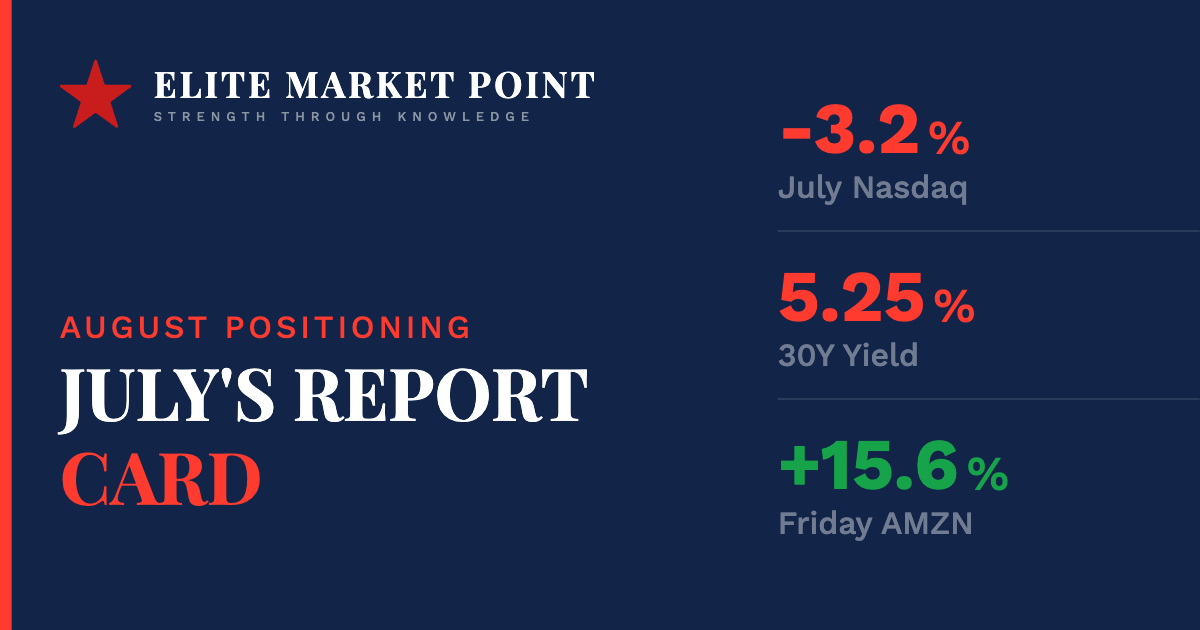
Saturday, August 1, 2026 – S&P 500 closed Friday at 7,489.72 (+0.67%). Dow 52,485 (+0.53%). Nasdaq 25,374 (+1.32%). July scorecard: S&P −0.1%. Nasdaq −3.2%. Nasdaq 100 −7%. Dow +0.3% (4th straight monthly gain). 30-year yield: 5.25%. 10-year: 4.737%. Brent: $90.12. Gold: $4,092. VIX: 17.09. Amazon +15.6% Friday. Apple −7.3% Friday.
Key Idea
July 2026 will be remembered as the month the AI trade split into winners and casualties. Microsoft added $450 billion in one day, the largest single-day gain in stock market history. Amazon cleared $200 billion in quarterly revenue for the first time and surged 15.6% on Friday. Apple lost $361 billion in market value in a single session after Tim Cook’s final earnings call as CEO. The biggest AI hedge fund in history got margin-called and sold everything to Citadel. The 30-year Treasury yield closed at 5.25%, the highest since 2007. Brent crude swung between $72 and $102 in a single month. And Iran attacked two tankers in the Strait of Hormuz on the last trading day. The question heading into August is not whether the AI trade survives. It already answered that. The question is whether the bond market lets it run.
Our Partners
Editor’s Note: Jeff Brown and Marc Chaikin, two investment legends who picked Nvidia 10 years ago, are predicting that by the end of this month, Elon Musk’s new AI breakthrough will collide with a strange market pattern with a flawless 100% track record of massive market gains. Click here to see the details or read more below because the last time this happened everyday folks had a chance to turn $10,000 into as much as $350,000 in just about 12 months.
Dear Reader,
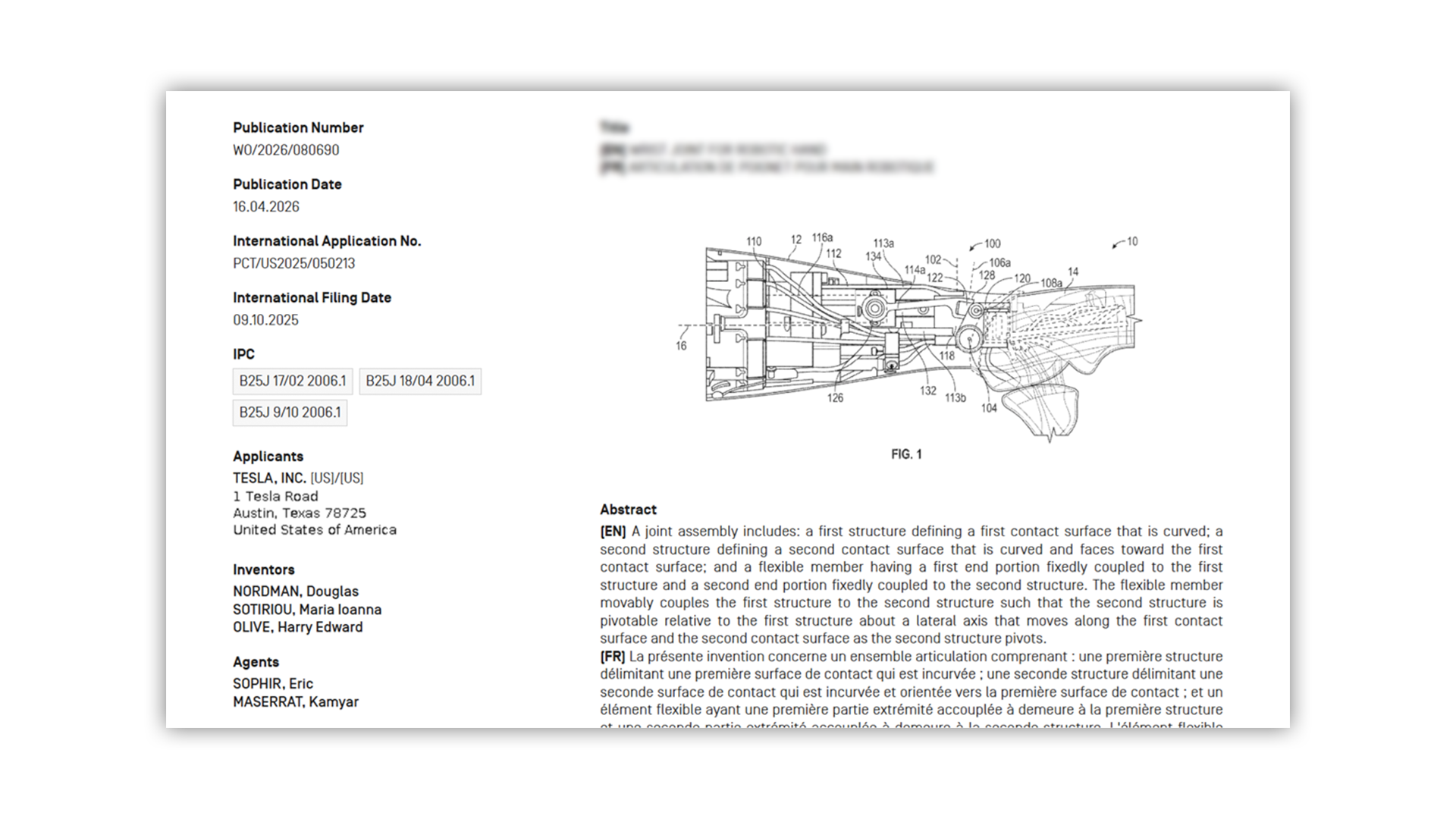
Take a look at Elon Musk’s new patent below…
Because it protects a new invention that could rewrite the future of wealth forever.
I’m talking about a radical new form of AI I call “M.A.G.I.”
One so revolutionary that Elon called it an “infinite money glitch.”
Click here to see the details because he believes this is a once-in-a-generation opportunity to create wealth on a scale most people can’t even comprehend.
What’s the upside potential here?
I know this is going to sound crazy…
But Elon is projecting growth of over 7,000,000%.
Let that sink in.
That’s enough to turn $100 into more than $7 million.
This sounds absolutely insane.
But then again… everything Elon has ever done sounded insane at first.
Self-driving cars. Reusable rockets that land themselves. Brain chips that let paralyzed people control computers with their minds.
Crazy ideas. But he turned them into trillion-dollar realities.
So here’s the real question…
Will you watch Elon build another empire from the sidelines…
Or will you finally position yourself to potentially become one of the winners in his next trillion-dollar revolution?
Click here to get the details because I believe Elon will flip the switch on this new invention by the end of this month.
We have so much to look forward to,
Jeff Brown
Founder & CEO, Brownstone Research
THE JULY SCORECARD
Four weeks. Five catalysts. Seven Magnificent stocks reporting. A war. A Fed decision. A hedge fund blowup. And the bond market reaching yields not seen since before the 2008 financial crisis. Here is what July did to your money.
The S&P 500 finished July almost exactly where it started, down 0.1%. That flat number hides the violence underneath. The index dropped 3.5% in the middle of the month as the Iran-US ceasefire collapsed and chip stocks sold off, then recovered nearly all of it on Microsoft and Amazon earnings in the final two sessions.
The Nasdaq fell 3.2% for the month, its worst July since 2004. The Nasdaq 100 fell 7%, its steepest monthly decline since March 2025. The iShares Momentum Factor ETF dropped 12%, one of the worst months in its history. But the Dow rose 0.3%, its fourth straight monthly gain, powered by healthcare, financials, and industrials rotating in as tech rotated out.
That divergence is the story. July was not a bear market. It was a rotation. Money did not leave the market. It left the AI infrastructure trade and moved into the companies that generate cash without spending $50 billion a quarter on data centers.
The S&P 500 finished July almost exactly where it started, down 0.1%. That flat number hides the violence underneath. The index dropped 3.5% in the middle of the month as the Iran-US ceasefire collapsed and chip stocks sold off, then recovered nearly all of it on Microsoft and Amazon earnings in the final two sessions.
The Nasdaq fell 3.2% for the month, its worst July since 2004. The Nasdaq 100 fell 7%, its steepest monthly decline since March 2025. The iShares Momentum Factor ETF dropped 12%, one of the worst months in its history. But the Dow rose 0.3%, its fourth straight monthly gain, powered by healthcare, financials, and industrials rotating in as tech rotated out.
That divergence is the story. July was not a bear market. It was a rotation. Money did not leave the market. It left the AI infrastructure trade and moved into the companies that generate cash without spending $50 billion a quarter on data centers.
THE FIVE VERDICTS
Microsoft. Added $450 billion in one day, the largest single-day gain in stock market history. Azure grew 43% and guided 45% for next quarter. Capex came in below estimates. Market cap: $3.35 trillion. The AI thesis proved.
Amazon. Surged 15.6% on Friday, its biggest one-day gain in over a decade. Revenue crossed $200 billion for the first time. AWS grew 37%, the fastest in 18 quarters. AI and chips businesses each topped $25 billion in annualized revenue. But free cash flow was negative $7.6 billion and capex guidance rose to $220 billion for 2026. The thesis is working. The cash is not.
Apple. Fell 7.3% on Friday, its worst day in 16 months, shedding roughly $361 billion in market value. Revenue hit a June quarter record of $109.4 billion. iPhone grew 22%. Mac grew 29%. But Services missed. China missed. Gross margin guidance dropped to 47%–48% as tariff refunds expire and memory costs surge. Tim Cook called the chip shortage a “100-year flood.” His last earnings call as CEO ends with a harder story than the one he rode to $5 trillion. John Ternus takes over September 1.
Meta. Fell 8% after hours Wednesday. Revenue grew 28% but EPS missed by 14%. Free cash flow collapsed 91% to $784 million. Operating margin dropped from 43% to 31%. Capex guidance raised to $130–$145 billion. The ad business works. Nothing else does yet.
Alphabet. Started the cascade. Raised its 2026 capex forecast to $195–$205 billion. Free cash flow turned negative. The stock dropped 7% and dragged every AI name down with it. Then rallied 7.1% on Friday as the market decided the selloff was overdone. Alphabet is the barometer. Where it goes, the sector follows.
Amazon. Surged 15.6% on Friday, its biggest one-day gain in over a decade. Revenue crossed $200 billion for the first time. AWS grew 37%, the fastest in 18 quarters. AI and chips businesses each topped $25 billion in annualized revenue. But free cash flow was negative $7.6 billion and capex guidance rose to $220 billion for 2026. The thesis is working. The cash is not.
Apple. Fell 7.3% on Friday, its worst day in 16 months, shedding roughly $361 billion in market value. Revenue hit a June quarter record of $109.4 billion. iPhone grew 22%. Mac grew 29%. But Services missed. China missed. Gross margin guidance dropped to 47%–48% as tariff refunds expire and memory costs surge. Tim Cook called the chip shortage a “100-year flood.” His last earnings call as CEO ends with a harder story than the one he rode to $5 trillion. John Ternus takes over September 1.
Meta. Fell 8% after hours Wednesday. Revenue grew 28% but EPS missed by 14%. Free cash flow collapsed 91% to $784 million. Operating margin dropped from 43% to 31%. Capex guidance raised to $130–$145 billion. The ad business works. Nothing else does yet.
Alphabet. Started the cascade. Raised its 2026 capex forecast to $195–$205 billion. Free cash flow turned negative. The stock dropped 7% and dragged every AI name down with it. Then rallied 7.1% on Friday as the market decided the selloff was overdone. Alphabet is the barometer. Where it goes, the sector follows.
The Bond Market Is the Boss Now
The 30-year Treasury yield closed July at 5.25%. The 10-year hit 4.737%. These are not just numbers. They are the price of everything.
At 5.25% on the long bond, a 30-year mortgage is above 7%. Corporate borrowing costs are at decade highs. Every company with floating-rate debt is paying more. Every company planning a bond offering is paying more. Every pension fund allocating between stocks and bonds is looking at a 5.25% risk-free return and asking why it should own equities at all.
The bond selloff accelerated during Warsh’s press conference on Wednesday when three Fed officials dissented for a hike. The market heard three words from Warsh that moved yields more than any data point: “There is only 2%.” The bond market interpreted that as a promise to keep rates elevated until inflation falls, which means the 30-year will not ease until CPI cooperates or the economy slows enough to force cuts.
For your portfolio, August starts with the bond market as the dominant force. Not earnings. Not AI. Not oil. The 30-year yield at 5.25% is the gravitational pull that every other asset must overcome to go higher. Microsoft can add $450 billion in a day, but if the long bond keeps climbing, even Microsoft’s rally has a ceiling.
At 5.25% on the long bond, a 30-year mortgage is above 7%. Corporate borrowing costs are at decade highs. Every company with floating-rate debt is paying more. Every company planning a bond offering is paying more. Every pension fund allocating between stocks and bonds is looking at a 5.25% risk-free return and asking why it should own equities at all.
The bond selloff accelerated during Warsh’s press conference on Wednesday when three Fed officials dissented for a hike. The market heard three words from Warsh that moved yields more than any data point: “There is only 2%.” The bond market interpreted that as a promise to keep rates elevated until inflation falls, which means the 30-year will not ease until CPI cooperates or the economy slows enough to force cuts.
For your portfolio, August starts with the bond market as the dominant force. Not earnings. Not AI. Not oil. The 30-year yield at 5.25% is the gravitational pull that every other asset must overcome to go higher. Microsoft can add $450 billion in a day, but if the long bond keeps climbing, even Microsoft’s rally has a ceiling.
Our View
July taught three lessons. Write them down.
First, the AI trade is narrowing to companies that convert spending into cash flow. Microsoft and Amazon passed the test. Meta, Alphabet, and the AI infrastructure buildout did not. Apple got a different punishment — not for spending too much, but for running into the supply consequences of everyone else’s spending. Memory costs are up. Lead times are stretched. Cook called it a 100-year flood. Ternus inherits the flood.
Second, leverage kills even when the thesis is right. Aschenbrenner’s Situational Awareness was up 439% through June. It ran 4x leverage on the correct view that AI would reshape markets. It did not survive a 25% drawdown in the assets it was right about. Citadel now owns the positions at distressed prices. The lesson for every individual investor: being right and being solvent are two different skills. Never confuse one for the other.
Third, the bond market is the boss. The 30-year at 5.25% is the ceiling on everything. It caps equity valuations, it raises borrowing costs, and it gives pension funds and institutional allocators a risk-free alternative to stocks that they have not had since before the financial crisis. Until yields come down, every rally in equities is renting its gains, not owning them.
Heading into August, here is how we are positioned. Own the cloud winners: Microsoft and Amazon proved their thesis. Hold Apple through the transition but watch September quarter guidance closely. Avoid concentrated semiconductor bets — the SOX fell 28.6% from its June peak and the Aschenbrenner unwind showed what forced selling looks like. Keep 5–8% in cash or short-duration Treasuries. Respect the bond market. And remember that August and September are historically the weakest months for equities.
July was not a crash. It was a repricing. The companies that survived it are the ones worth owning in August. The ones that did not are still figuring out whether their spending produces anything other than a capex line item.
Welcome to the second half.
First, the AI trade is narrowing to companies that convert spending into cash flow. Microsoft and Amazon passed the test. Meta, Alphabet, and the AI infrastructure buildout did not. Apple got a different punishment — not for spending too much, but for running into the supply consequences of everyone else’s spending. Memory costs are up. Lead times are stretched. Cook called it a 100-year flood. Ternus inherits the flood.
Second, leverage kills even when the thesis is right. Aschenbrenner’s Situational Awareness was up 439% through June. It ran 4x leverage on the correct view that AI would reshape markets. It did not survive a 25% drawdown in the assets it was right about. Citadel now owns the positions at distressed prices. The lesson for every individual investor: being right and being solvent are two different skills. Never confuse one for the other.
Third, the bond market is the boss. The 30-year at 5.25% is the ceiling on everything. It caps equity valuations, it raises borrowing costs, and it gives pension funds and institutional allocators a risk-free alternative to stocks that they have not had since before the financial crisis. Until yields come down, every rally in equities is renting its gains, not owning them.
Heading into August, here is how we are positioned. Own the cloud winners: Microsoft and Amazon proved their thesis. Hold Apple through the transition but watch September quarter guidance closely. Avoid concentrated semiconductor bets — the SOX fell 28.6% from its June peak and the Aschenbrenner unwind showed what forced selling looks like. Keep 5–8% in cash or short-duration Treasuries. Respect the bond market. And remember that August and September are historically the weakest months for equities.
July was not a crash. It was a repricing. The companies that survived it are the ones worth owning in August. The ones that did not are still figuring out whether their spending produces anything other than a capex line item.
Welcome to the second half.