
Bessent Launched the Largest Sanctions Offensive in History. A Tanker Was Struck in Hormuz. Oil Fell.
★ ELITE MARKET POINT
Market Intelligence That Moves With You
ECONOMIC D-DAY
Bessent Launched the Largest Sanctions Offensive in History. A Tanker Was Struck in Hormuz. Oil Fell. That Is the Signal.
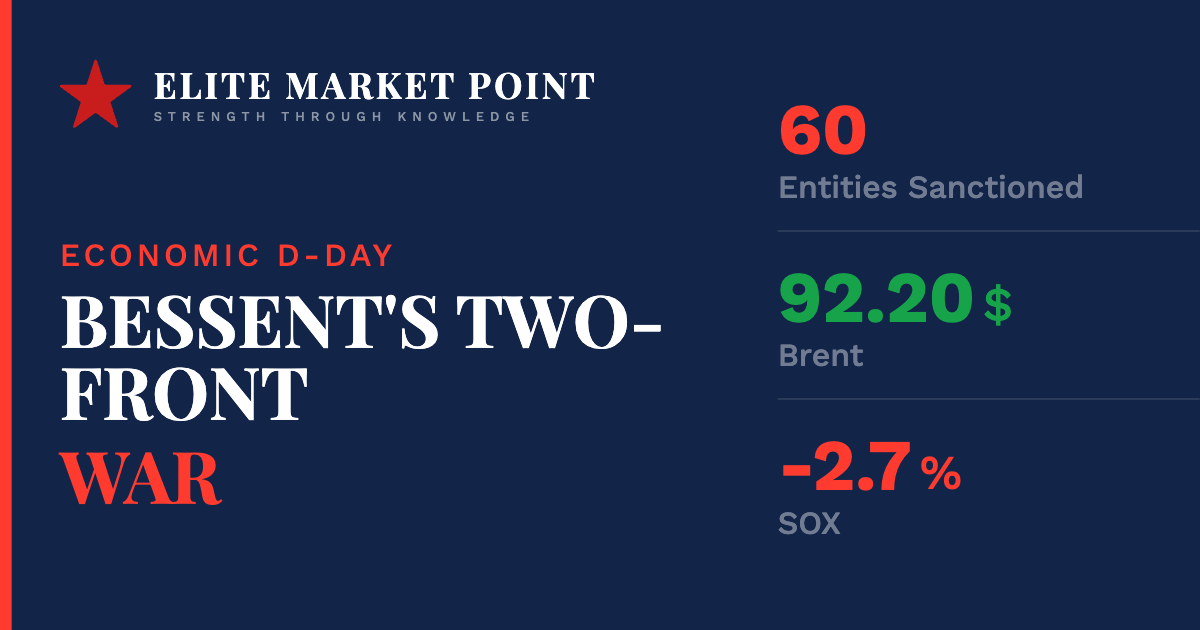
Operation Economic Outcast hit 60 entities across five sectors. Iran threatened to seize ships. A projectile hit a vessel near Oman. And Brent dropped 2.3% to $92. The market is not pricing escalation anymore. It is pricing the endgame. Nvidia reports tomorrow after the close.
Tuesday, August 25, 2026 • S&P 500: 7,652.86 • Brent: $92.20 • 30-Year Yield: 5.22% • NVDA: $214.72
Key Idea
Treasury Secretary Bessent launched what he called “Operation Economic Outcast” on Monday morning. He sanctioned 60 corporations, individuals, and vessels. He targeted five of Iran’s economic lifelines: shipping, oil, digital assets, gold, and aviation. He said at least one major financial institution would face sanctions this week. He warned China would not be exempt. Iran responded by threatening to seize ships in Hormuz. A tanker was struck by an unknown projectile near Oman the same morning. And Brent crude fell 2.3%. Read that again. The largest sanctions offensive in history, a vessel attack, and a seizure threat, and oil went down. The market is no longer pricing escalation. It is pricing resolution or collapse. One of those two outcomes is now weeks away. And Bessent is fighting on two fronts: Iran abroad and the bond market at home.
Our Partners
Editor’s Note: Jeff Brown and Marc Chaikin, two investment legends who picked Nvidia 10 years ago, are predicting that by the end of this month, Elon Musk’s new AI breakthrough will collide with a strange market pattern with a flawless 100% track record of massive market gains. Click here to see the details or read more below because the last time this happened everyday folks had a chance to turn $10,000 into as much as $350,000 in just about 12 months.
Dear Reader,
For the first time ever…
The two investment legends who picked Nvidia 10 years ago…
Are coming together to issue an urgent buy alert…
On this little-known Elon Musk supplier that’s perfectly positioned for what Nvidia’s CEO called…
“The next multi-trillion-dollar industry.” (Click here to see the details.)
Jeff Brown is a former tech executive who picked Nvidia in early 2016, before shares jumped as high as 36,000%.
Marc Chaikin is a 60-year Wall Street titan who’s worked with billionaires and hedge fund legends like Paul Tudor Jones, George Soros, and Steve Cohen.
And they both believe this could be the single biggest investment opportunity of this century.
Regards,
Lindsey Hough
Managing Director, Brownstone Research
For the first time ever…
The two investment legends who picked Nvidia 10 years ago…
Are coming together to issue an urgent buy alert…
On this little-known Elon Musk supplier that’s perfectly positioned for what Nvidia’s CEO called…
“The next multi-trillion-dollar industry.” (Click here to see the details.)
Jeff Brown is a former tech executive who picked Nvidia in early 2016, before shares jumped as high as 36,000%.
Marc Chaikin is a 60-year Wall Street titan who’s worked with billionaires and hedge fund legends like Paul Tudor Jones, George Soros, and Steve Cohen.
And they both believe this could be the single biggest investment opportunity of this century.
Regards,
Lindsey Hough
Managing Director, Brownstone Research
OPERATION ECONOMIC OUTCAST
Bessent posted on X Sunday evening: “At dawn begins an economic D-Day.” Monday morning he delivered it from a press conference at the Treasury Building, flanked by OFAC officials holding binders of designations.
The scope is unprecedented. Nearly 60 entities sanctioned in a single action. Targets include Chinese nationals facilitating Iranian oil shipments, UAE-based brokers running shadow-fleet tankers, and individuals tied to the National Iranian Oil Company and the IRGC-Quds Force. Among the named: Mohammad Ahmed Suhil Fattouh, a Syrian national based in the UAE whom Treasury described as a longtime broker of shadow-fleet vessels. Also named: Ukrainian national Ivan Obukhov and his company Foscom FZE.
Treasury said it has “mapped Iran’s oil-smuggling and sanctions-evasion network” and is presenting the intelligence to governments with defined timelines to shut down Iran-related activities. Companies facilitating evasion risk losing access to the US financial system. Bessent said secondary sanctions are being accelerated. He called it an “economic onslaught” designed to “sever every economic pipeline until Tehran stands alone.”
Trump is making phone calls to world leaders with what Bessent called “specific requests.” That phrase is diplomatic language for ultimatums. The target is Iran’s oil revenue. The collateral damage is every country that buys it. China purchases roughly 90% of Iran’s exported crude. If Bessent follows through on sanctioning Chinese banks, he is not just isolating Iran. He is picking a second economic fight with the world’s second largest economy while running a $1.9 trillion deficit.
The scope is unprecedented. Nearly 60 entities sanctioned in a single action. Targets include Chinese nationals facilitating Iranian oil shipments, UAE-based brokers running shadow-fleet tankers, and individuals tied to the National Iranian Oil Company and the IRGC-Quds Force. Among the named: Mohammad Ahmed Suhil Fattouh, a Syrian national based in the UAE whom Treasury described as a longtime broker of shadow-fleet vessels. Also named: Ukrainian national Ivan Obukhov and his company Foscom FZE.
Treasury said it has “mapped Iran’s oil-smuggling and sanctions-evasion network” and is presenting the intelligence to governments with defined timelines to shut down Iran-related activities. Companies facilitating evasion risk losing access to the US financial system. Bessent said secondary sanctions are being accelerated. He called it an “economic onslaught” designed to “sever every economic pipeline until Tehran stands alone.”
Trump is making phone calls to world leaders with what Bessent called “specific requests.” That phrase is diplomatic language for ultimatums. The target is Iran’s oil revenue. The collateral damage is every country that buys it. China purchases roughly 90% of Iran’s exported crude. If Bessent follows through on sanctioning Chinese banks, he is not just isolating Iran. He is picking a second economic fight with the world’s second largest economy while running a $1.9 trillion deficit.
THE TANKER, THE THREAT, AND THE PRICE
UK Maritime Trade Operations reported Monday that a vessel was struck by an “unknown projectile” while conducting an outbound transit of the Strait of Hormuz near the Omani coast. The impact damaged the engine room and caused a crew casualty. The Omani Coast Guard assisted the remaining crew.
Iran’s Armed Forces chief of staff warned of a “crushing, regret-inducing and devastating” response. Iran’s foreign ministry said Tehran had the right to charge vessels transit fees through Hormuz and would enforce them. Translation: Iran is threatening to seize commercial ships that do not pay.
The UAE suspended all trade with Iran over an alleged missile attack. That cuts Tehran’s last major re-export hub. Iran is now economically surrounded on paper. But 16 million barrels still crossed Hormuz in a single night last week, according to tracking data. Flows vary. The strait is not closed. It is contested. And contested is enough to keep the war premium in oil without pushing it higher.
That is why Brent fell to $92.20. The market has absorbed six months of Hormuz risk. It is no longer shocked by attacks. It is pricing probability. And the probability it sees is binary: either Bessent’s sanctions work and Iran comes to the table within weeks, or they fail and the next move is military. In both scenarios, oil moves sharply. In neither scenario does it stay at $92.
Iran’s Armed Forces chief of staff warned of a “crushing, regret-inducing and devastating” response. Iran’s foreign ministry said Tehran had the right to charge vessels transit fees through Hormuz and would enforce them. Translation: Iran is threatening to seize commercial ships that do not pay.
The UAE suspended all trade with Iran over an alleged missile attack. That cuts Tehran’s last major re-export hub. Iran is now economically surrounded on paper. But 16 million barrels still crossed Hormuz in a single night last week, according to tracking data. Flows vary. The strait is not closed. It is contested. And contested is enough to keep the war premium in oil without pushing it higher.
That is why Brent fell to $92.20. The market has absorbed six months of Hormuz risk. It is no longer shocked by attacks. It is pricing probability. And the probability it sees is binary: either Bessent’s sanctions work and Iran comes to the table within weeks, or they fail and the next move is military. In both scenarios, oil moves sharply. In neither scenario does it stay at $92.
NVIDIA EVE: THE FINAL POSITIONING WINDOW
Nvidia reports tomorrow, Wednesday August 26, after the close. The call starts at 5 PM Eastern. This is the last full trading session to position.
The setup has shifted since yesterday. SOX has now fallen five consecutive sessions. Chips led the S&P 500 lower on Monday. Micron dropped 5.8%. AMD fell 3%. Broadcom lost 2%. SanDisk fell another 6%. The semiconductor sector is entering Nvidia’s report in its weakest posture since early July.
But futures are up this morning. Nasdaq futures gained 0.5% overnight. SanDisk and Micron both turned green in Blue Ocean overnight trading. The market wants to buy the dip before Nvidia. The question is whether the report justifies the bid.
Consensus: $91.8 billion revenue, $93.5 billion whisper, $2.09–$2.13 adjusted EPS. Q3 guidance consensus: $103.1 billion. Gross margin: 75%. Those are the numbers. Everything above them is bullish. Everything below them triggers the beat-and-sell pattern that has defined the past two weeks.
Options are pricing a 10% move in either direction. That is $330 billion in market cap at risk on a single print. There is no other company on earth where one earnings report moves that much value. Position today or watch from the sideline. There is no middle ground.
The setup has shifted since yesterday. SOX has now fallen five consecutive sessions. Chips led the S&P 500 lower on Monday. Micron dropped 5.8%. AMD fell 3%. Broadcom lost 2%. SanDisk fell another 6%. The semiconductor sector is entering Nvidia’s report in its weakest posture since early July.
But futures are up this morning. Nasdaq futures gained 0.5% overnight. SanDisk and Micron both turned green in Blue Ocean overnight trading. The market wants to buy the dip before Nvidia. The question is whether the report justifies the bid.
Consensus: $91.8 billion revenue, $93.5 billion whisper, $2.09–$2.13 adjusted EPS. Q3 guidance consensus: $103.1 billion. Gross margin: 75%. Those are the numbers. Everything above them is bullish. Everything below them triggers the beat-and-sell pattern that has defined the past two weeks.
Options are pricing a 10% move in either direction. That is $330 billion in market cap at risk on a single print. There is no other company on earth where one earnings report moves that much value. Position today or watch from the sideline. There is no middle ground.
THREE SCENARIOS FOR THE NEXT 48 HOURS
Base
Nvidia reports $93 billion revenue. Margins hold at 75%. Q3 guide hits $103–$104 billion. The stock moves 5–7% higher in after-hours. SOX rallies 3% Wednesday. The sanctions create noise but no new military escalation. Brent holds $90–$93. The S&P recovers above 7,700. The 30-year yield holds near 5.22%. You hold NVDA if you own it. You do not add above $230 until Jackson Hole clears Friday.
Upside
Nvidia reports $95 billion or above. Blackwell margins surprise at 76%. Q3 guide tops $105 billion. The stock surges 12–15% to above $240. SOX rallies 5–7%. Iran signals willingness to negotiate under sanctions pressure, pulling Brent below $88. The 30-year yield drops below 5.15% as the war endgame narrative takes hold. The S&P pushes above 7,850. Jay Woods of Freedom Capital Markets said “if there’s a path to 8,000, it’s going to be led by Nvidia.” This is the scenario where that path opens. If you own SMH and XLE, you hold SMH and trim XLE.
Risk
Nvidia beats on revenue but Blackwell margins compress below 74%. Q3 guide comes in at $101 billion or below. The stock drops 10–12%. SOX falls 5–7% Wednesday, extending its losing streak to six sessions. Iran retaliates against the sanctions with a military strike. Brent spikes above $95. Bessent’s two-front war collapses: the bond market sells off on war risk and the equity market sells off on margin compression. The S&P breaks below 7,550. The 30-year yield retests 5.34%. Defense stocks and gold are the only safe ground. Cash at 5.25% is the trade. If you are unhedged going into tomorrow’s close, you are carrying the single largest overnight risk of 2026.
Our View
Bessent is now fighting on two fronts and we are watching both in real time.
Front one: Iran. Operation Economic Outcast is the most aggressive sanctions action since the Russian embargo of 2022. Sixty entities in one day. Five economic sectors targeted simultaneously. Secondary sanctions expanded to shipping. China warned publicly. But here is the tell: Brent fell. The market looked at the largest sanctions offensive in history, a projectile hitting a tanker in Hormuz, and Iran threatening to seize ships, and it sold oil. That only makes sense if the market believes these sanctions accelerate the endgame. Either Iran capitulates within weeks or the next escalation is kinetic. In both scenarios the current price is wrong. Oil moves sharply from here. The direction depends on which endgame arrives first.
Front two: the bond market. Yields moved lower Monday after CNBC reported that Treasury may use the General Account to fund buyback operations. That is Bessent’s second intervention in eight days. The first doubled buybacks. The second may deploy the government’s cash reserves. Each intervention works for hours. Each one tells the market that the Treasury Secretary is improvising. JPMorgan said it last week: these measures “belie the structural challenges.” Bessent knows this. He is buying time. The question is: time for what?
The answer arrives in 30 hours. Nvidia reports tomorrow after the close. If Nvidia beats and holds, it validates the AI spending cycle that keeps the two-speed economy running. Bessent gets his reprieve. If Nvidia beats and sells off, the repricing that has already taken down AMAT, SNDK, TGT, and WMT reaches the center of the market and Bessent’s time runs out.
Then Friday. Warsh speaks at Jackson Hole. PCE prints at 8:30 AM. If core inflation drops below 2.6%, the hawks lose their argument. If it rises above 2.8%, September is live. Warsh has said nothing about what he will say. That blank piece of paper is now the most consequential document in global finance.
Two fronts. Two events. Thirty hours until Nvidia. Seventy-two until Warsh. This is the week we have been building toward for ten editions. We will be here Wednesday morning with the verdict.
Front one: Iran. Operation Economic Outcast is the most aggressive sanctions action since the Russian embargo of 2022. Sixty entities in one day. Five economic sectors targeted simultaneously. Secondary sanctions expanded to shipping. China warned publicly. But here is the tell: Brent fell. The market looked at the largest sanctions offensive in history, a projectile hitting a tanker in Hormuz, and Iran threatening to seize ships, and it sold oil. That only makes sense if the market believes these sanctions accelerate the endgame. Either Iran capitulates within weeks or the next escalation is kinetic. In both scenarios the current price is wrong. Oil moves sharply from here. The direction depends on which endgame arrives first.
Front two: the bond market. Yields moved lower Monday after CNBC reported that Treasury may use the General Account to fund buyback operations. That is Bessent’s second intervention in eight days. The first doubled buybacks. The second may deploy the government’s cash reserves. Each intervention works for hours. Each one tells the market that the Treasury Secretary is improvising. JPMorgan said it last week: these measures “belie the structural challenges.” Bessent knows this. He is buying time. The question is: time for what?
The answer arrives in 30 hours. Nvidia reports tomorrow after the close. If Nvidia beats and holds, it validates the AI spending cycle that keeps the two-speed economy running. Bessent gets his reprieve. If Nvidia beats and sells off, the repricing that has already taken down AMAT, SNDK, TGT, and WMT reaches the center of the market and Bessent’s time runs out.
Then Friday. Warsh speaks at Jackson Hole. PCE prints at 8:30 AM. If core inflation drops below 2.6%, the hawks lose their argument. If it rises above 2.8%, September is live. Warsh has said nothing about what he will say. That blank piece of paper is now the most consequential document in global finance.
Two fronts. Two events. Thirty hours until Nvidia. Seventy-two until Warsh. This is the week we have been building toward for ten editions. We will be here Wednesday morning with the verdict.