
The Jobs Report Broke. The Dow Didn't Care. Here's What That Means.
★ ELITE MARKET POINT
Market Intelligence That Moves With You
A quick note from the Elite Market Point desk.
We owe you an apology. We missed several days of sends while migrating to a new email platform.
To make sure these editions land in your primary inbox and not spam or promotions, please reply to this email with any word, or drag it into your Primary tab if you use Gmail. That one step keeps us connected.
Thank you for your patience. We are glad to be back, and we will keep earning your open every single morning.
We owe you an apology. We missed several days of sends while migrating to a new email platform.
To make sure these editions land in your primary inbox and not spam or promotions, please reply to this email with any word, or drag it into your Primary tab if you use Gmail. That one step keeps us connected.
Thank you for your patience. We are glad to be back, and we will keep earning your open every single morning.
Independence Day Weekend • What Thursday Decided
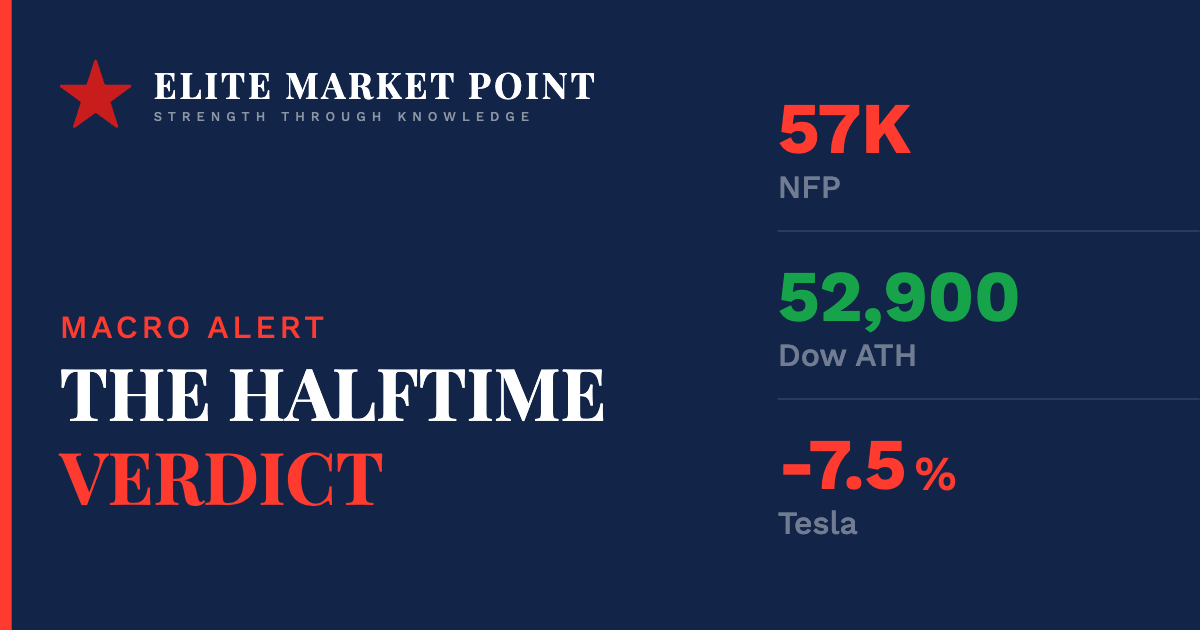
57,000 Jobs. Dow Record. Tesla Delivered 480K Cars and Lost 7.5%.
Thursday’s jobs report was the weakest in months. The Dow closed at an all-time high the same afternoon. The market is not confused. It is repricing what Warsh does next.
Friday, July 3, 2026 • Markets closed for Independence Day • SpaceX joins the Nasdaq-100 Monday
Key Idea
The economy added 57,000 jobs in June. That is roughly half what Wall Street expected. Prior months were revised down by a combined 74,000. The Dow responded by climbing 595 points to 52,900. A new all-time high. On the same day, Tesla delivered 480,126 vehicles, crushing estimates by 18%. The stock fell 7.5%. Three different asset classes gave three different answers to the same data. They all said the same thing: the rate-hike trade is dying.
What the Number Actually Said
Nonfarm payrolls: 57,000. The estimate was 110,000 to 115,000. But the miss was not the real story. The real story was underneath it.
May was revised down from 172,000 to 129,000. April was revised down from 179,000 to 148,000. Combined: 74,000 jobs that Wall Street thought existed simply did not. The economy did not just slow in June. It was weaker than reported for three straight months.
The gains came from healthcare, social assistance, and professional services. Nearly every other sector flatlined. Leisure and hospitality lost 61,000 positions — restaurants, hotels, bars. The BLS pointed to weaker-than-usual seasonal hiring, partly a World Cup effect.
The unemployment rate ticked down to 4.2%. That sounds good until you see why. Labor force participation fell to 61.5%. That is the lowest since March 2021. The rate dropped because people stopped looking, not because they found work. If participation had held steady, unemployment would have risen.
Wages rose 0.3% for the month and 3.5% over the past year. Still above the Fed’s comfort zone. Fewer jobs. Same wage pressure. That is the combination Warsh warned about in Sintra two days earlier.
May was revised down from 172,000 to 129,000. April was revised down from 179,000 to 148,000. Combined: 74,000 jobs that Wall Street thought existed simply did not. The economy did not just slow in June. It was weaker than reported for three straight months.
The gains came from healthcare, social assistance, and professional services. Nearly every other sector flatlined. Leisure and hospitality lost 61,000 positions — restaurants, hotels, bars. The BLS pointed to weaker-than-usual seasonal hiring, partly a World Cup effect.
The unemployment rate ticked down to 4.2%. That sounds good until you see why. Labor force participation fell to 61.5%. That is the lowest since March 2021. The rate dropped because people stopped looking, not because they found work. If participation had held steady, unemployment would have risen.
Wages rose 0.3% for the month and 3.5% over the past year. Still above the Fed’s comfort zone. Fewer jobs. Same wage pressure. That is the combination Warsh warned about in Sintra two days earlier.
Why the Dow Hit a Record on Bad News
By 9:15 Thursday morning, every Dow component except four was green. The 57,000 print had killed the September rate-hike narrative in a single release.
Traders at the CME repriced immediately. That is the exchange where interest rate futures trade. The 2-year Treasury yield, the bond most sensitive to Fed expectations, fell 3.5 basis points to 4.13%. When short-term rates drop, stocks tied to the domestic economy go up. Apple climbed 4.8%. McDonald’s rose 4%. Disney gained 3.8%. Those are Dow stocks. That is why the Dow rallied 595 points while the Nasdaq dropped 0.8%.
Think about that for a second. The index tracking 30 American blue chips hit a record. The index tracking tech and AI fell. Same data. Opposite conclusions. The Dow heard “no rate hike.” The Nasdaq heard “the economy is slowing and AI spending might follow.”
Chips got hit for a second straight day. The VanEck Semiconductor ETF, ticker SMH, dropped 4.5%. Teradyne fell 13.6%. KLA fell 11.5%. Micron lost another 5.5%. After gaining 80% in the first half, the chip trade has shed double digits in two sessions. That is institutional distribution, not profit-taking.
Traders at the CME repriced immediately. That is the exchange where interest rate futures trade. The 2-year Treasury yield, the bond most sensitive to Fed expectations, fell 3.5 basis points to 4.13%. When short-term rates drop, stocks tied to the domestic economy go up. Apple climbed 4.8%. McDonald’s rose 4%. Disney gained 3.8%. Those are Dow stocks. That is why the Dow rallied 595 points while the Nasdaq dropped 0.8%.
Think about that for a second. The index tracking 30 American blue chips hit a record. The index tracking tech and AI fell. Same data. Opposite conclusions. The Dow heard “no rate hike.” The Nasdaq heard “the economy is slowing and AI spending might follow.”
Chips got hit for a second straight day. The VanEck Semiconductor ETF, ticker SMH, dropped 4.5%. Teradyne fell 13.6%. KLA fell 11.5%. Micron lost another 5.5%. After gaining 80% in the first half, the chip trade has shed double digits in two sessions. That is institutional distribution, not profit-taking.
Tesla Delivered Everything and the Market Sold It
The delivery report landed at 7:00 AM Eastern. By 9:31, the stock was already down 4%.
Tesla reported 480,126 deliveries for Q2. The estimate was 406,024. An 18% beat. Year-over-year growth of 25%. Quarter-over-quarter growth of 34%. Energy storage hit 13.5 gigawatt-hours, up 53% from Q1.
The stock fell 7.49%. Worst day in nearly a year.
Three reasons. First, the stock rallied 8% the prior week on a self-driving software update. The beat was priced in. Second, investors want to see margins, not volume. That answer arrives July 22 when Tesla reports full earnings. Third, gas prices. The average gallon is $3.83 according to AAA. Oil below $68 helps commuters. It weakens the EV case.
Here is where it gets interesting. Tesla trades at 204 times forward earnings. Its $1.52 trillion valuation prices in AI, autonomous driving, and robotics. Not cars. A delivery beat proves the car business is recovering. It does not prove the AI thesis. That is why the stock fell on a number that beat estimates by 74,000 vehicles.
Tesla reported 480,126 deliveries for Q2. The estimate was 406,024. An 18% beat. Year-over-year growth of 25%. Quarter-over-quarter growth of 34%. Energy storage hit 13.5 gigawatt-hours, up 53% from Q1.
The stock fell 7.49%. Worst day in nearly a year.
Three reasons. First, the stock rallied 8% the prior week on a self-driving software update. The beat was priced in. Second, investors want to see margins, not volume. That answer arrives July 22 when Tesla reports full earnings. Third, gas prices. The average gallon is $3.83 according to AAA. Oil below $68 helps commuters. It weakens the EV case.
Here is where it gets interesting. Tesla trades at 204 times forward earnings. Its $1.52 trillion valuation prices in AI, autonomous driving, and robotics. Not cars. A delivery beat proves the car business is recovering. It does not prove the AI thesis. That is why the stock fell on a number that beat estimates by 74,000 vehicles.
The Participation Rate Nobody Mentioned
The headline was the 57,000 miss. The real number was 61.5%. That is the share of working-age Americans either employed or looking for work. It fell three-tenths of a point in a single month. Half a million people vanished from the labor force. The Dow’s record close was built on a number that was soft for the wrong reason. That distinction will matter when Warsh reads the full report this weekend.
Three Scenarios for the Week Ahead
Base
SpaceX joins the Nasdaq-100 Monday. J.P. Morgan estimates $4.3 billion in forced passive buying. SPCX trades $155–175 as inclusion offsets post-IPO selling. The Dow holds 52,500–53,200. Chip rotation continues. If you hold SMH, trim another 5% and rotate into XLV or XLP, the healthcare and consumer staples ETFs that led Thursday’s rally. Oil drifts to $65–68. The 2-year yield holds 4.05–4.20%. CPI on July 14 becomes the next binary event.
Upside
ISM Services on Thursday comes in below 50, confirming the jobs miss was not a fluke. Rate-hike probability for September drops below 15%. The 10-year falls below 4.40%. Growth stocks rally 2–3%. KOSPI’s 5.76% rebound Friday signals the global chip selloff is exhausted. Micron and AMD bounce 5–8%. SpaceX inclusion triggers a broader space and defense bid. Dow pushes toward 53,500. S&P 500 retests 7,550.
Risk
The soft jobs print triggers a “bad news is actually bad news” repricing. Early earnings pre-announcements reveal margin pressure from wages and tariff costs. SpaceX inclusion forces selling of existing Nasdaq-100 constituents, creating a 1–2% drag. Tesla margin fear spreads to other consumer cyclicals. Nasdaq drops below 25,500. Credit spreads widen, signaling recession risk rather than rate relief. A 2–3% S&P 500 pullback sets up a volatile earnings season starting mid-July.
Our View
We told you Thursday morning that one number at 8:30 would decide the second half. The number was 57,000. Half of what anyone expected.
If you own a diversified portfolio, Thursday was a gift. Blue chips rallied. Defensive sectors led. Oil fell to $67. Your gas bill is dropping. Your mortgage rate stopped climbing. That is what a weak jobs print means for your kitchen table.
But here is the part nobody is discussing yet. The July 14 CPI report will be the first to capture energy prices after oil fell 28% from its May peak. If headline inflation drops meaningfully, Warsh loses his strongest argument for keeping rates elevated. The market is pricing in patience. CPI could price in something more.
The first half delivered 14.9% on the S&P 500. The second half started with a record Dow and a falling Nasdaq. A Fed chair who refuses to give guidance and a labor market that just cracked its first real fissure. SpaceX joins the Nasdaq-100 Monday. CPI lands July 14. Earnings season starts the week after.
Your job between now and then is simple. Own the deployers. Trim the builders. Let the data do the work. The second half will not be boring. It has already started.
If you own a diversified portfolio, Thursday was a gift. Blue chips rallied. Defensive sectors led. Oil fell to $67. Your gas bill is dropping. Your mortgage rate stopped climbing. That is what a weak jobs print means for your kitchen table.
But here is the part nobody is discussing yet. The July 14 CPI report will be the first to capture energy prices after oil fell 28% from its May peak. If headline inflation drops meaningfully, Warsh loses his strongest argument for keeping rates elevated. The market is pricing in patience. CPI could price in something more.
The first half delivered 14.9% on the S&P 500. The second half started with a record Dow and a falling Nasdaq. A Fed chair who refuses to give guidance and a labor market that just cracked its first real fissure. SpaceX joins the Nasdaq-100 Monday. CPI lands July 14. Earnings season starts the week after.
Your job between now and then is simple. Own the deployers. Trim the builders. Let the data do the work. The second half will not be boring. It has already started.