
The Ceasefire Died. Trump Threatened an Ally. The 30-Year Yield Hit a 19-Year High Before You Woke Up.
★ ELITE MARKET POINT
Market Intelligence That Moves With You
WAR ESCALATION
The Ceasefire Died. The President Threatened an Ally. The Bond Market Priced It In Before You Woke Up.
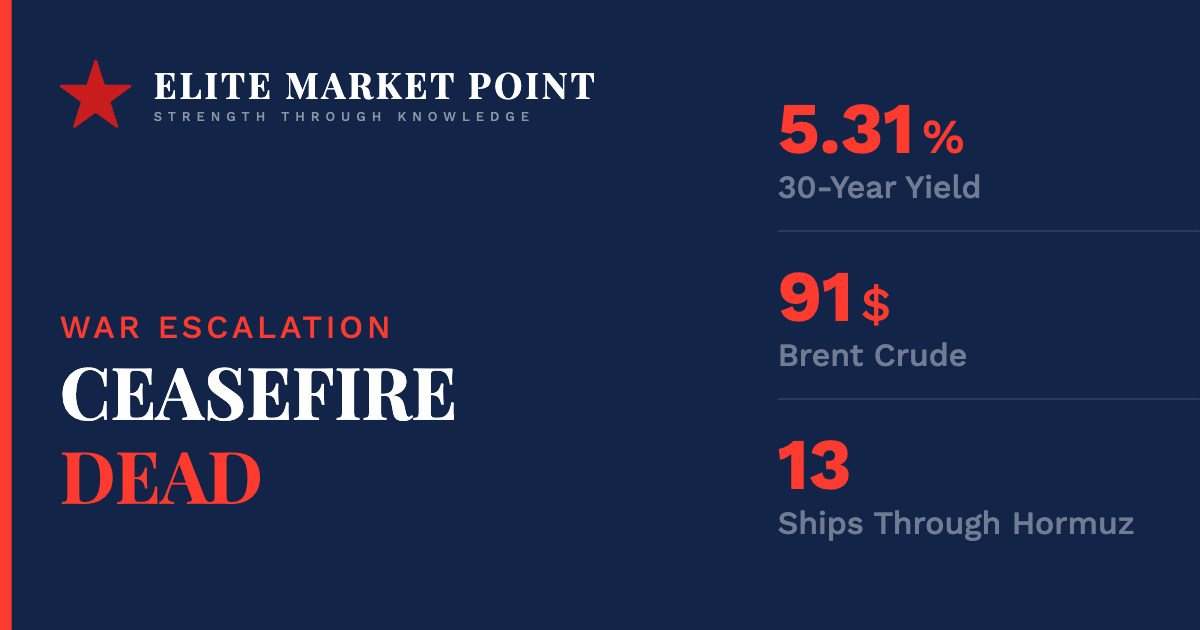
The US-Iran memorandum of understanding expired Monday. Hormuz traffic fell to 13 ships. Brent touched $91. The 30-year yield hit the highest level since 2007. Home Depot reports in two hours.
Tuesday, August 18, 2026 • S&P 500: 7,745.06 • Brent Crude: $91.02 • 30-Year Yield: 5.31% • 10-Year Yield: 4.72%
Key Idea
The 60-day ceasefire between the United States and Iran expired Monday with no deal, no extension, and no path forward. President Trump threatened to bomb Oman, a US ally, if it interfered with Hormuz. Iran declared it had shifted to a “fully offensive” posture. Shipping through the strait fell to 13 vessels over the weekend. Three on Sunday. The 30-year Treasury yield hit 5.31%, the highest since 2007. That is the bond market telling you the war is not ending. And it is pricing the cost into your mortgage, your car loan, and every year of federal borrowing for the next three decades.
Our Partners

📲 No, it’s not the publicly traded tech giant you might expect… Meet $MODE, the disruptor turning phones into income generators.
📱 Mode’s 32,481% revenue growth ranked them #1 on Deloitte’s list of fastest-growing companies in software. They aim to pioneer “Privatized Universal Basic Income” powered by technology, not government, and their EarnPhone has already helped consumers earn & save $1B+.
Invest today and earn up to 20% bonus shares.
📱 Mode’s 32,481% revenue growth ranked them #1 on Deloitte’s list of fastest-growing companies in software. They aim to pioneer “Privatized Universal Basic Income” powered by technology, not government, and their EarnPhone has already helped consumers earn & save $1B+.
Invest today and earn up to 20% bonus shares.
Disclaimers
Please read the offering circular and related risks at invest.modemobile.com. This is a paid advertisement for Mode Mobile’s Regulation A+ Offering.
Mode Mobile recently received their ticker reservation with Nasdaq ($MODE), indicating an intent to IPO in the next 24 months. An intent to IPO is no guarantee that an actual IPO will occur.
The Deloitte rankings are based on submitted applications and public company database research, with winners selected based on their fiscal-year revenue growth percentage over a three-year period.
Please read the offering circular and related risks at invest.modemobile.com. This is a paid advertisement for Mode Mobile’s Regulation A+ Offering.
Mode Mobile recently received their ticker reservation with Nasdaq ($MODE), indicating an intent to IPO in the next 24 months. An intent to IPO is no guarantee that an actual IPO will occur.
The Deloitte rankings are based on submitted applications and public company database research, with winners selected based on their fiscal-year revenue growth percentage over a three-year period.
THE CEASEFIRE IS DEAD
The memorandum of understanding signed June 17 in Islamabad gave Washington and Tehran 60 days to negotiate a final deal. That window closed Monday. Neither side extended it.
The agreement was supposed to halt military operations, reopen the Strait of Hormuz, and start talks on Iran’s nuclear program. It did none of those things. Trump declared the MoU “over” on July 8, less than a month after signing it. Both sides resumed strikes. Iran hit US bases in Gulf states and Jordan. The US launched waves of attacks on what Tehran called civilian infrastructure, killing at least 50 people.
Iranian Foreign Minister Abbas Araghchi said Saturday there were no plans to restart negotiations with Washington. A senior Iranian official told Reuters that Tehran had shifted from a defensive posture to a “fully offensive” one. That official said Iran would conduct a “timely and precise” military attack to break the US naval blockade if talks collapse entirely.
Think about what that means for the barrel of oil sitting in your gas tank. Hormuz carried 20 million barrels a day before the war started on February 28. On Sunday, three ships crossed it. Three. Pre-war traffic averaged 100 to 135 vessels daily. The strait is not closed on paper. It is closed in practice.
The agreement was supposed to halt military operations, reopen the Strait of Hormuz, and start talks on Iran’s nuclear program. It did none of those things. Trump declared the MoU “over” on July 8, less than a month after signing it. Both sides resumed strikes. Iran hit US bases in Gulf states and Jordan. The US launched waves of attacks on what Tehran called civilian infrastructure, killing at least 50 people.
Iranian Foreign Minister Abbas Araghchi said Saturday there were no plans to restart negotiations with Washington. A senior Iranian official told Reuters that Tehran had shifted from a defensive posture to a “fully offensive” one. That official said Iran would conduct a “timely and precise” military attack to break the US naval blockade if talks collapse entirely.
Think about what that means for the barrel of oil sitting in your gas tank. Hormuz carried 20 million barrels a day before the war started on February 28. On Sunday, three ships crossed it. Three. Pre-war traffic averaged 100 to 135 vessels daily. The strait is not closed on paper. It is closed in practice.
THE OMAN THREAT
Trump told Fox News on Monday morning that if Oman “gets in the way, we’ll bomb” them. Oman is a US ally. It borders the Strait of Hormuz. It has been mediating between Iran and the international community for decades.
Iran and Oman had been negotiating a separate agreement on shipping routes through the strait. Iran’s foreign ministry said Saturday that a deal with Oman had been reached, though details were not released. Trump’s threat appeared aimed at preventing any arrangement that gave Iran a role in managing Hormuz traffic.
Senator Tim Kaine said Monday he would introduce a resolution barring military action against Oman when the Senate returns from recess. The threat drew immediate condemnation from Gulf allies. Oman is not Iran. It hosts a US military presence. It brokered the original 2015 nuclear talks. Threatening to bomb it tells every mediator in the region that helping end this war carries a personal risk.
That is not diplomacy. That is how you run out of mediators.
Iran and Oman had been negotiating a separate agreement on shipping routes through the strait. Iran’s foreign ministry said Saturday that a deal with Oman had been reached, though details were not released. Trump’s threat appeared aimed at preventing any arrangement that gave Iran a role in managing Hormuz traffic.
Senator Tim Kaine said Monday he would introduce a resolution barring military action against Oman when the Senate returns from recess. The threat drew immediate condemnation from Gulf allies. Oman is not Iran. It hosts a US military presence. It brokered the original 2015 nuclear talks. Threatening to bomb it tells every mediator in the region that helping end this war carries a personal risk.
That is not diplomacy. That is how you run out of mediators.
THE BOND MARKET SPOKE FIRST
The 30-year Treasury yield climbed to 5.31% on Monday. That is the highest since June 2007. The last time lenders demanded this much to hold American debt for three decades, the iPhone had just gone on sale and Lehman Brothers was a Wall Street titan.
The 10-year yield rose to 4.72%. That is a 19-month high. The 30-year auction earlier this month cleared at its highest yield since 2001. Five of the last seven 20-year auctions have tailed. That means buyers demanded a premium above the expected price. The government is running out of cheap lenders.
Three forces are driving the move. First, the US is issuing enormous volumes of debt. Second, tariffs and energy costs are keeping inflation sticky. Third, the market is recalibrating to Fed Chair Kevin Warsh, who has signaled that rate hikes may not be his preferred tool. When the chair says he won’t fight inflation with rates, the long end of the curve fights it for him. By demanding more yield.
Here is what 5.31% costs you. A 30-year fixed mortgage now carries a rate above 7.2%. That adds roughly $430 a month to a $400,000 loan compared to where rates sat in September 2024. Auto loan rates above 8% are standard for prime borrowers. Corporate borrowing costs are climbing. AI companies alone have raised $1.5 trillion in bonds this year, lifting the supply of dollar-denominated debt and crowding out Treasury demand.
The bond market does not care about headlines. It prices duration risk. And right now it is saying: this war is structural, this deficit is structural, and you will pay for both.
The 10-year yield rose to 4.72%. That is a 19-month high. The 30-year auction earlier this month cleared at its highest yield since 2001. Five of the last seven 20-year auctions have tailed. That means buyers demanded a premium above the expected price. The government is running out of cheap lenders.
Three forces are driving the move. First, the US is issuing enormous volumes of debt. Second, tariffs and energy costs are keeping inflation sticky. Third, the market is recalibrating to Fed Chair Kevin Warsh, who has signaled that rate hikes may not be his preferred tool. When the chair says he won’t fight inflation with rates, the long end of the curve fights it for him. By demanding more yield.
Here is what 5.31% costs you. A 30-year fixed mortgage now carries a rate above 7.2%. That adds roughly $430 a month to a $400,000 loan compared to where rates sat in September 2024. Auto loan rates above 8% are standard for prime borrowers. Corporate borrowing costs are climbing. AI companies alone have raised $1.5 trillion in bonds this year, lifting the supply of dollar-denominated debt and crowding out Treasury demand.
The bond market does not care about headlines. It prices duration risk. And right now it is saying: this war is structural, this deficit is structural, and you will pay for both.
THE WEEK THAT DECIDES EVERYTHING
Home Depot reports before the bell this morning. Wall Street expects $4.71 EPS on $47.5 billion in revenue. CEO Ted Decker is on medical leave since August 12. Interim leadership takes the earnings call into a market that just sold off Applied Materials after a record quarter. If HD beats and sells off too, the rotation signal is confirmed.
Target reports Wednesday. Walmart reports Thursday. FOMC minutes from the July 28–29 meeting drop Wednesday at 2 PM. That meeting ended 9–3, with three regional presidents dissenting in favor of a rate hike. The minutes will reveal how many others were sympathetic. Markets see a 67% chance the Fed holds in September. But foreign holders of Treasurys fell in June. The UK, China, and Japan all reduced their positions. Somebody is selling American debt.
Friday brings the Jackson Hole preview via flash PMIs. Nvidia reports August 26 with $92 billion in expected revenue. Oil at $91 and Hormuz at 13 ships per weekend is not a backdrop that lets the Fed stay quiet. This week decides whether the war premium stays priced in or accelerates.
Target reports Wednesday. Walmart reports Thursday. FOMC minutes from the July 28–29 meeting drop Wednesday at 2 PM. That meeting ended 9–3, with three regional presidents dissenting in favor of a rate hike. The minutes will reveal how many others were sympathetic. Markets see a 67% chance the Fed holds in September. But foreign holders of Treasurys fell in June. The UK, China, and Japan all reduced their positions. Somebody is selling American debt.
Friday brings the Jackson Hole preview via flash PMIs. Nvidia reports August 26 with $92 billion in expected revenue. Oil at $91 and Hormuz at 13 ships per weekend is not a backdrop that lets the Fed stay quiet. This week decides whether the war premium stays priced in or accelerates.
THREE SCENARIOS FOR THIS WEEK
Base
Oil holds between $88 and $93. The Oman threat produces no military action and is walked back by State Department officials within 48 hours. Home Depot delivers $4.71 EPS, comps print flat, and the stock trades sideways near $340. Walmart meets consensus Thursday. FOMC minutes show concern about inflation but no consensus for a September hike. The S&P holds 7,700–7,780. The 30-year yield stays above 5.25%. Gold holds above $4,400. You stay positioned but do not add risk. XLE, the energy ETF, holds as a hedge.
Upside
Iran and Oman finalize a shipping protocol for Hormuz. Even a partial reopening to 40–50 vessels per day would pull Brent below $85 within 48 hours. The 30-year yield retreats below 5.15%. Home Depot surprises above $4.80 EPS and raises guidance. Walmart reports accelerating e-commerce. The S&P pushes back above 7,800. Consumer discretionary (XLY) rallies 2–3%. FOMC minutes read dovish. September hike odds drop below 25%. If you own energy (XLE), you take partial profit. If you own consumer discretionary (XLY), you hold.
Risk
Iran conducts the “timely and precise” attack it warned about. Even a single strike on a US escort vessel would send Brent above $100 within hours. The 30-year yield spikes to 5.50–5.70%, the range Fundstrat’s Mark Newton flagged Monday. The S&P drops 3–5% in two sessions. Home Depot misses and interim leadership offers cautious commentary without Decker’s authority. Target and Walmart guide down citing gas prices. September hike odds climb above 50%. XLY drops 4–6% for the week. Defense stocks (LMT, RTX, NOC) and gold (GLD) become the only safe ground. If you are not hedged, you are exposed. TLT, the long-bond ETF, falls another 2–3% as yields surge. Cash earns 5.25% at the front end. That is not a bad place to wait.
Our View
Yesterday we told you the S&P and the consumer were pricing two different economies. Today they are pricing two different wars. The stock market is 0.5% off its record. The bond market just hit a 19-year high in yield. The S&P says the war is priced in. The 30-year says it is not.
One of them is wrong. We think it is the stock market.
When Brent opened at $91 this morning, it crossed a threshold. At $90 oil, the average American household pays roughly $220 more per month on fuel and energy compared to a year ago. That is $2,640 a year. That is not an abstraction. That is the vacation that gets canceled, the dining out that stops, the retail spending that Walmart measures every Thursday morning.
The bond market sees three things the stock market is ignoring. First, the ceasefire is dead and no mediator wants to replace Oman after Trump’s threat. Second, the deficit is $1.9 trillion and climbing, and the government needs to sell bonds into a market where the UK, China, and Japan are all reducing holdings. Third, AI capital spending is issuing $1.5 trillion in corporate bonds this year alone, competing with Treasurys for the same pool of global savings.
That is why 5.31% matters more than 7,745. The yield tells you the cost of everything. The index tells you the price of optimism. When the cost of everything rises while the price of optimism stays flat, something breaks. Watch Home Depot this morning. If it beats and the stock drops, the bond market is winning. That is the signal that matters before the bell.
One of them is wrong. We think it is the stock market.
When Brent opened at $91 this morning, it crossed a threshold. At $90 oil, the average American household pays roughly $220 more per month on fuel and energy compared to a year ago. That is $2,640 a year. That is not an abstraction. That is the vacation that gets canceled, the dining out that stops, the retail spending that Walmart measures every Thursday morning.
The bond market sees three things the stock market is ignoring. First, the ceasefire is dead and no mediator wants to replace Oman after Trump’s threat. Second, the deficit is $1.9 trillion and climbing, and the government needs to sell bonds into a market where the UK, China, and Japan are all reducing holdings. Third, AI capital spending is issuing $1.5 trillion in corporate bonds this year alone, competing with Treasurys for the same pool of global savings.
That is why 5.31% matters more than 7,745. The yield tells you the cost of everything. The index tells you the price of optimism. When the cost of everything rises while the price of optimism stays flat, something breaks. Watch Home Depot this morning. If it beats and the stock drops, the bond market is winning. That is the signal that matters before the bell.