
The Ceasefire Died at 5:45 PM. The Fed Speaks at 2:00. By 6:00 PM Tonight, You'll Know the Direction.
★ ELITE MARKET POINT
Market Intelligence That Moves With You
FOMC DAY
The Ceasefire Died at 5:45 PM. Oil Spiked. Warsh Speaks in Hours.
Iran fired ballistic missiles at US forces overnight. Saudi Arabia struck Iraq for the first time since the war started. The Fed decides at 2:00 PM.
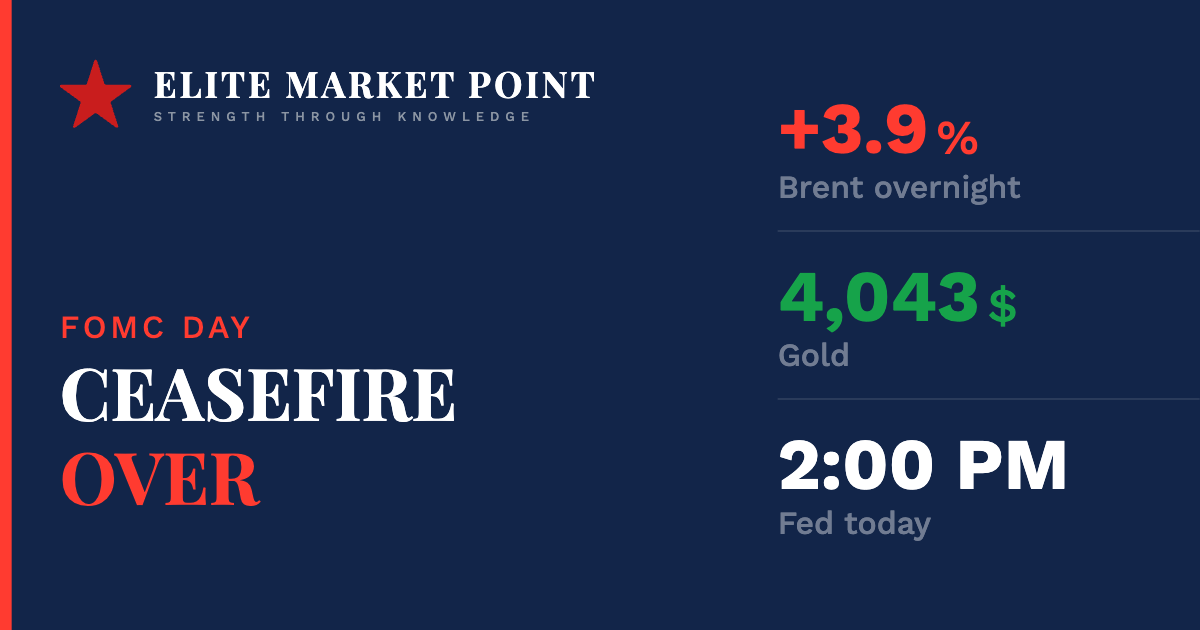
Wednesday, July 29, 2026 – S&P 500 closed Tuesday at 7,428.78 (+0.21%). Dow 52,747 (+1.03%). Nasdaq 24,877 (−0.22%). Brent spiked to ~$87.39 (+3.9% overnight). WTI ~$82.31 (+3.8%). Gold: $4,043. Apple briefly hit $5T market cap. VIX: 18.31. Fed decision 2:00 PM. Warsh presser 2:30 PM. Microsoft + Meta report after close.
Key Idea
At 5:45 PM Eastern on Tuesday, Iran launched ballistic missiles at US forces in the Middle East. All were intercepted. Hours later, Saudi Arabia and the US conducted joint precision strikes on Iran-backed militia sites across eastern Iraq. It was Saudi Arabia’s first acknowledged military strike inside Iraq since the war began in February. Oil jumped 4%. Gold rose. The ceasefire that held for 72 hours is finished. And in less than six hours, Kevin Warsh will walk to a podium and tell you what the Fed thinks about inflation in a world where oil cannot stay below $85 for more than three days.
Our Partners
Immersed
TRACTION REPORT
The numbers behind Immersed, in one place.
No story, just the traction. Here is what the company has built so far, while the Reg A+ round is open at $0.79 per share.
1.5M+
Platform Users
$7M+
Revenue to Date
$37M+
Raised to Date
9,800+
Investors
1.75B
Social Views
75,000+
Visor Waitlist
The current share price is $0.79. The share price deadline is July 30.
invest.immersed.com • Reg A+ offering • Share price deadline July 30
This is a paid advertisement for Immersed made pursuant to a Regulation A+ offering and involves risk, including the possible loss of your entire investment. Shares are not publicly traded and are illiquid. No IPO or NASDAQ listing is guaranteed. Please read the offering circular and related risks at invest.immersed.com. The valuation is set by the Company and there is currently no public market for the Company’s Common Stock. Financial figures are unaudited and past performance does not guarantee future results. Tier pricing is set by the Company; prior pricing does not indicate future value.
WHAT HAPPENED OVERNIGHT
The sequence matters. On Tuesday afternoon, oil was falling and markets were calm. Iran was in talks with Saudi Arabia and Oman about the Strait of Hormuz. Brent closed at $84.09, down 4.8% on the day. It looked like diplomacy was working.
Then at 5:45 PM Eastern, the IRGC launched ballistic missiles at a US airbase and a CENTCOM facility in Jordan. All missiles were intercepted. Jordan confirmed it shot down five of them. The US military called it an “attempted surprise attack.”
Hours later, Saudi Arabia responded. For the first time since the Iran war began in February, Riyadh acknowledged conducting military strikes inside Iraq. Saudi and US fighter aircraft hit what CENTCOM called “multiple terrorist logistics and weapons sites across eastern Iraq.” Iraq’s Popular Mobilisation Forces said at least 20 of its fighters were killed and 32 wounded. The PMF called it a “highly dangerous escalation” and a breach of Iraqi sovereignty.
Meanwhile, Saudi Arabia also intercepted drones from Iraq-based militias targeting petroleum facilities in the Eastern Province and Riyadh. A Houthi attack forced Aramco to shut a refinery. The war just expanded from two parties to three theaters: Iran proper, Iraq, and Yemen.
Brent jumped 3.9% to $87.39 overnight. WTI rose 3.8% to $82.31. The three-day oil selloff that followed the ceasefire whisper is already half erased.
Then at 5:45 PM Eastern, the IRGC launched ballistic missiles at a US airbase and a CENTCOM facility in Jordan. All missiles were intercepted. Jordan confirmed it shot down five of them. The US military called it an “attempted surprise attack.”
Hours later, Saudi Arabia responded. For the first time since the Iran war began in February, Riyadh acknowledged conducting military strikes inside Iraq. Saudi and US fighter aircraft hit what CENTCOM called “multiple terrorist logistics and weapons sites across eastern Iraq.” Iraq’s Popular Mobilisation Forces said at least 20 of its fighters were killed and 32 wounded. The PMF called it a “highly dangerous escalation” and a breach of Iraqi sovereignty.
Meanwhile, Saudi Arabia also intercepted drones from Iraq-based militias targeting petroleum facilities in the Eastern Province and Riyadh. A Houthi attack forced Aramco to shut a refinery. The war just expanded from two parties to three theaters: Iran proper, Iraq, and Yemen.
Brent jumped 3.9% to $87.39 overnight. WTI rose 3.8% to $82.31. The three-day oil selloff that followed the ceasefire whisper is already half erased.
THE FOUR-HOUR WINDOW
We told you Monday that Wednesday from 2:00 to 6:00 PM Eastern would define the second half of 2026. That window opens in hours.
At 2:00 PM, the FOMC announces its rate decision. FactSet consensus says hold at 3.5%–3.75%. That is the fifth straight meeting with no change. But the overnight missile attack just made the press conference far more unpredictable than anyone expected 12 hours ago.
At 2:30 PM, Warsh takes the podium. He has pledged to provide less forward guidance than his predecessors. He has not submitted personal economic projections. He has set up task forces to rethink how the Fed communicates. All of that means the press conference will be shorter, blunter, and harder to read than anything Powell gave you.
The question every trader will ask: does Warsh reference oil? If he says inflation risks remain “elevated” and links it to energy, September becomes a live hike meeting. Markets are already pricing an 80% probability of a September rate increase. If he does not mention oil at all, it signals the Fed views the energy shock as temporary and hike odds fall. Gold and bonds rally. Stocks breathe.
Then at 4:05 PM, Microsoft reports. At 4:15, Meta. Azure growth and Meta’s ad revenue will tell you whether the AI capex that crashed the chip market last week is producing actual returns. By 6:00 PM, you will know the rate path, the AI path, and the war path. All three in four hours.
At 2:00 PM, the FOMC announces its rate decision. FactSet consensus says hold at 3.5%–3.75%. That is the fifth straight meeting with no change. But the overnight missile attack just made the press conference far more unpredictable than anyone expected 12 hours ago.
At 2:30 PM, Warsh takes the podium. He has pledged to provide less forward guidance than his predecessors. He has not submitted personal economic projections. He has set up task forces to rethink how the Fed communicates. All of that means the press conference will be shorter, blunter, and harder to read than anything Powell gave you.
The question every trader will ask: does Warsh reference oil? If he says inflation risks remain “elevated” and links it to energy, September becomes a live hike meeting. Markets are already pricing an 80% probability of a September rate increase. If he does not mention oil at all, it signals the Fed views the energy shock as temporary and hike odds fall. Gold and bonds rally. Stocks breathe.
Then at 4:05 PM, Microsoft reports. At 4:15, Meta. Azure growth and Meta’s ad revenue will tell you whether the AI capex that crashed the chip market last week is producing actual returns. By 6:00 PM, you will know the rate path, the AI path, and the war path. All three in four hours.
Why Saudi Arabia Striking Iraq Changes Everything
Saudi Arabia has absorbed Iranian attacks for five months without retaliating directly. Riyadh intercepted drones, reinforced air defenses, and let Washington do the bombing. That restraint ended overnight.
The joint US-Saudi strikes inside Iraq mark a structural escalation. Saudi Arabia invoked Article 51 of the UN Charter, the right to self-defense. That is the legal language countries use before a sustained campaign, not a one-off retaliation.
For your portfolio, this changes the oil calculus. Saudi Arabia is now an active combatant with targets inside Iraq. Iran-backed militias in Iraq have promised a “harsh response.” If those militias attack Saudi oil infrastructure from Iraqi soil in response, Riyadh has already established the legal precedent to strike back. The conflict loop just added a new node. Every additional node makes de-escalation harder and oil volatility wider.
If you hold energy stocks (XLE, XOP), this overnight expansion is bullish short-term. If you hold airlines (DAL, UAL) or consumer discretionary (XLY), it is not. Fuel costs were falling for three days. They are rising again this morning.
The joint US-Saudi strikes inside Iraq mark a structural escalation. Saudi Arabia invoked Article 51 of the UN Charter, the right to self-defense. That is the legal language countries use before a sustained campaign, not a one-off retaliation.
For your portfolio, this changes the oil calculus. Saudi Arabia is now an active combatant with targets inside Iraq. Iran-backed militias in Iraq have promised a “harsh response.” If those militias attack Saudi oil infrastructure from Iraqi soil in response, Riyadh has already established the legal precedent to strike back. The conflict loop just added a new node. Every additional node makes de-escalation harder and oil volatility wider.
If you hold energy stocks (XLE, XOP), this overnight expansion is bullish short-term. If you hold airlines (DAL, UAL) or consumer discretionary (XLY), it is not. Fuel costs were falling for three days. They are rising again this morning.
THREE WAYS TODAY PLAYS OUT
Base
The Fed holds at 3.5%–3.75%. Warsh keeps the press conference short, acknowledges “elevated inflation risks” but declines to signal a September hike explicitly. Markets read this as hawkish-hold. Oil stays in the $85–$90 range. Microsoft beats on revenue with Azure growing above 40% but guides capex higher. Meta beats on ad revenue but raises its spending outlook to $130–$150 billion. Both stocks dip 2–3% after hours on the capex numbers but stabilize by Thursday morning. The S&P 500 finishes Wednesday flat to down 0.5%. Gold holds near $4,050. If you own broad index funds (SPY, VOO), this is a hold-and-watch day. If you are concentrated in mega-cap tech, do not add until you see the full after-hours reaction to both earnings.
Upside
Warsh surprises dovish. He references the ceasefire collapse as a temporary supply shock and signals the Fed views June’s 3.5% CPI improvement as the real trend. September hike odds drop from 80% to below 50%. The 10-year yield falls 10–15 basis points. Microsoft shows Azure accelerating past 45% growth AND holds capex flat. The market rips. The S&P 500 jumps 1.5–2% by Thursday morning. Gold drops below $4,000 as rate-hike fear fades. The Nasdaq rallies 2–3%. Buy into any pullback in quality names: Microsoft (MSFT), Broadcom (AVGO), Apple (AAPL). The rotation from value back to growth begins.
Risk
Warsh uses the word “hike” or explicitly puts September on the table. The market had not priced this. Oil reclaims $90 on the Iraq escalation. Microsoft misses on Azure or guides capex above $90 billion for the quarter. Meta’s operating margin drops below 38%. The S&P 500 falls 2–3% by Thursday morning. The Nasdaq drops 3–5%. The 10-year yield pushes above 4.80%. Gold spikes above $4,100 on combined rate-hike shock and war escalation. The VIX jumps past 22. If you are fully invested with no cash buffer, this is the scenario that hurts. Keep 5–8% in short-duration Treasuries (SHV, BIL) or money market. Have a stop-loss plan for any concentrated semiconductor position. The SMH has already fallen over 17% this month.
Our View
We said Monday that five catalysts in four days would define the second half. Two of those catalysts have already fired. The ceasefire collapsed. The chip market cracked. Three remain: the Fed at 2:00, Microsoft and Meta after the bell, and Apple and Amazon tomorrow.
The ceasefire collapse is the one that changes Warsh’s calculus. Three days ago, oil was falling toward $84 and the case for a hawkish hold without a September signal was clean. This morning oil is back above $87 and Saudi Arabia is bombing Iraq. That puts Warsh in a corner. He can acknowledge the energy shock and risk sounding like he is signaling a hike. Or he can ignore it and risk looking out of touch.
Gold at $4,043 tells you the market is hedging both outcomes. It is down 27% from January’s $5,595 record, but it has held above $4,000 for two straight weeks despite rising yields and a stronger dollar. Central banks bought 244 tonnes of gold in Q1 alone. The floor is real. The question is whether Warsh gives it a reason to rally.
Apple briefly touched $5 trillion in market cap yesterday. That is a sentence that would have been science fiction two years ago. It happened because Apple spent less than everyone else. Remember that when you read the Microsoft and Meta capex numbers tonight.
By 6:00 PM tonight, the fog lifts. Be ready.
The ceasefire collapse is the one that changes Warsh’s calculus. Three days ago, oil was falling toward $84 and the case for a hawkish hold without a September signal was clean. This morning oil is back above $87 and Saudi Arabia is bombing Iraq. That puts Warsh in a corner. He can acknowledge the energy shock and risk sounding like he is signaling a hike. Or he can ignore it and risk looking out of touch.
Gold at $4,043 tells you the market is hedging both outcomes. It is down 27% from January’s $5,595 record, but it has held above $4,000 for two straight weeks despite rising yields and a stronger dollar. Central banks bought 244 tonnes of gold in Q1 alone. The floor is real. The question is whether Warsh gives it a reason to rally.
Apple briefly touched $5 trillion in market cap yesterday. That is a sentence that would have been science fiction two years ago. It happened because Apple spent less than everyone else. Remember that when you read the Microsoft and Meta capex numbers tonight.
By 6:00 PM tonight, the fog lifts. Be ready.