
Monday's CPI Might Print Negative. Don't Be Fooled.
★ ELITE MARKET POINT
Market Intelligence That Moves With You
The Sunday Long Read • CPI Eve
Monday’s CPI Might Print Negative. Don’t Be Fooled.
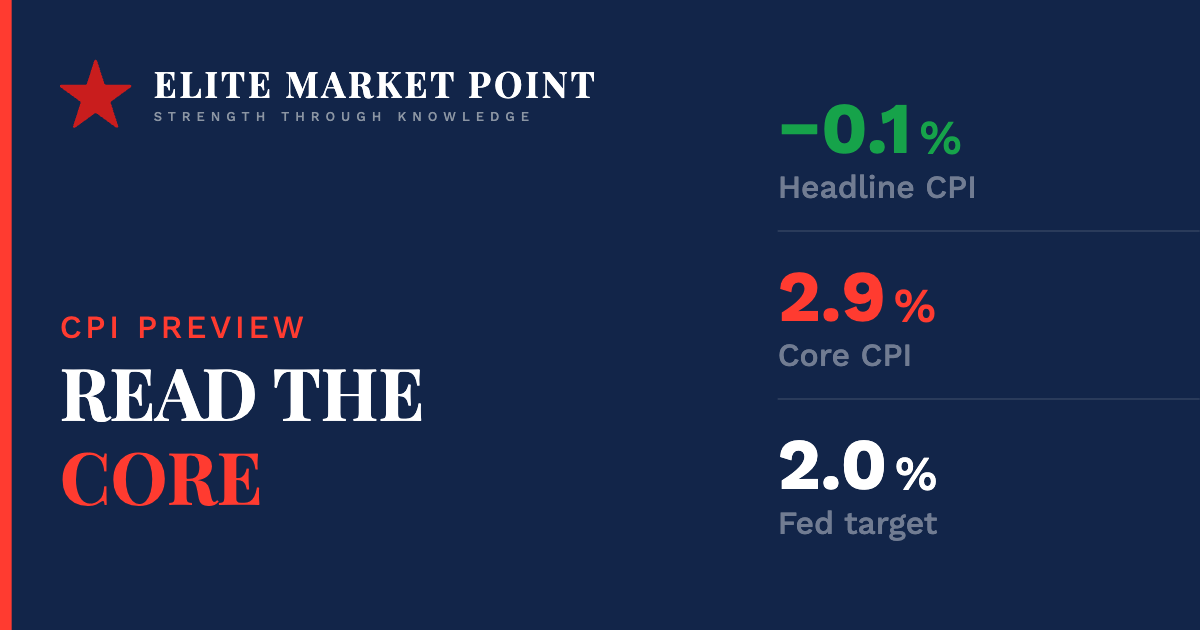
Gasoline fell 10% in June. The headline number will look soft. But core inflation is expected at 2.9%. That is exactly where it stood a year ago. The headline says cooling. The core says stuck. Warsh’s hawks read core. Your brokerage app shows headline. That gap is Monday’s entire trade.
Sunday, July 12, 2026 • CPI drops Monday 8:30 AM ET • Iran talks in Muscat • Earnings season begins this week
Key Idea
The Bureau of Labor Statistics releases June CPI at 8:30 Monday morning. BMO and the broader consensus expect headline inflation to drop 0.1% for the month. That would be the first negative monthly print in over a year. The annual rate is expected to fall from 4.2% to 3.9%. Sounds like progress. It is not. Gasoline fell 10% in June after the ceasefire reopened the Strait. That single move accounts for most of the decline. Strip out energy and food: core CPI is expected at 0.3% monthly and 2.9% annually. Core has not moved in twelve months. The Fed does not set policy on headlines. It sets policy on core. One number will dominate your news feed Monday morning. The other will dominate the next FOMC meeting on July 29.
Why the Headline Will Mislead You
May CPI was 4.2% year-over-year. That was the highest since April 2023. It came in hot because oil surged from $67 in early May to $94 at the peak. Energy prices accounted for over 60% of the monthly increase. Gasoline alone drove the number.
Then the ceasefire landed on June 17. Oil fell 21% in two weeks. Pump prices followed. BMO’s Douglas Porter estimates gasoline alone will shave four-tenths of a point from the monthly print. That mechanical reversal is almost the entire story. The headline will scream: inflation cooling. Cable news will run the chyron. Your brokerage app will flash green.
Now read the core. Core CPI strips out food and energy. It is expected at 0.3% for the month. That is the same pace it has run for most of the past year. The annual core rate: 2.9%. That is exactly where it was in July 2025. Twelve months of Fed tightening, a 57,000-job miss, and a global oil shock. Core did not move.
Shelter costs are the largest single component. They account for roughly a third of the CPI basket. They are still rising above 3% annually. Services inflation remains sticky in labor-intensive sectors. These are the numbers Warsh reads. These are the numbers that keep nine officials on the hike side of the 9-9 split.
Then the ceasefire landed on June 17. Oil fell 21% in two weeks. Pump prices followed. BMO’s Douglas Porter estimates gasoline alone will shave four-tenths of a point from the monthly print. That mechanical reversal is almost the entire story. The headline will scream: inflation cooling. Cable news will run the chyron. Your brokerage app will flash green.
Now read the core. Core CPI strips out food and energy. It is expected at 0.3% for the month. That is the same pace it has run for most of the past year. The annual core rate: 2.9%. That is exactly where it was in July 2025. Twelve months of Fed tightening, a 57,000-job miss, and a global oil shock. Core did not move.
Shelter costs are the largest single component. They account for roughly a third of the CPI basket. They are still rising above 3% annually. Services inflation remains sticky in labor-intensive sectors. These are the numbers Warsh reads. These are the numbers that keep nine officials on the hike side of the 9-9 split.
What Changed Since the Ceasefire Broke
Here is why Monday’s number is already stale before it prints. The June CPI captures a world where the ceasefire held and oil was falling. That world ended July 7. Trump declared the deal “over” from Ankara. Oil jumped from $71 to $78 in 48 hours. The Strait of Hormuz traffic fell sharply.
By Friday, oil had retreated to $71. Tankers resumed crossing. But the damage to the July data is already forming. Gas prices are climbing again, per AAA. The Iran oil sales waiver expires July 17. If the Strait tightens further, the July CPI print will reverse everything June gave back.
Meanwhile, diplomacy continues. Iran’s foreign minister traveled to Muscat Saturday for talks with Gulf leaders. Qatar mediated discussions in Tehran Friday evening that both sides called “positive.” Pakistan’s prime minister worked the phones with Iran’s president and Qatar’s emir. A new round of U.S.-Iran talks is expected next week, possibly in Switzerland.
Trump posted on Truth Social Friday: “The Islamic Republic of Iran has asked us to continue talks. We have agreed to do so. But the Cease Fire is OVER!” Talks alive. Ceasefire dead. Oil in limbo. That is the backdrop for Monday’s number.
By Friday, oil had retreated to $71. Tankers resumed crossing. But the damage to the July data is already forming. Gas prices are climbing again, per AAA. The Iran oil sales waiver expires July 17. If the Strait tightens further, the July CPI print will reverse everything June gave back.
Meanwhile, diplomacy continues. Iran’s foreign minister traveled to Muscat Saturday for talks with Gulf leaders. Qatar mediated discussions in Tehran Friday evening that both sides called “positive.” Pakistan’s prime minister worked the phones with Iran’s president and Qatar’s emir. A new round of U.S.-Iran talks is expected next week, possibly in Switzerland.
Trump posted on Truth Social Friday: “The Islamic Republic of Iran has asked us to continue talks. We have agreed to do so. But the Cease Fire is OVER!” Talks alive. Ceasefire dead. Oil in limbo. That is the backdrop for Monday’s number.
What Your Portfolio Faces This Week
Monday: CPI at 8:30. The single most important data point since the June jobs report. The market will trade the headline first. If it prints negative, expect an immediate rally in growth stocks and a drop in yields. The core will settle the session by afternoon.
Tuesday through Thursday: SK Hynix begins regular trading under the ticker SKHY. Earnings season builds momentum. Major bank earnings arrive Friday.
Friday July 17: JPMorgan, Wells Fargo, and Citigroup report before the bell. This is the first real test of whether the oil shock and rate uncertainty have dented lending margins and trading revenue. The Iran oil waiver also expires on July 17. Two catalysts on the same day.
The New York Fed’s latest survey showed one-year inflation expectations at 3.7% in June. That is the highest since September 2023. Consumer expectations are rising even as the headline number is about to drop. That divergence tells you the public does not believe the improvement is real. Neither should you.
Tuesday through Thursday: SK Hynix begins regular trading under the ticker SKHY. Earnings season builds momentum. Major bank earnings arrive Friday.
Friday July 17: JPMorgan, Wells Fargo, and Citigroup report before the bell. This is the first real test of whether the oil shock and rate uncertainty have dented lending margins and trading revenue. The Iran oil waiver also expires on July 17. Two catalysts on the same day.
The New York Fed’s latest survey showed one-year inflation expectations at 3.7% in June. That is the highest since September 2023. Consumer expectations are rising even as the headline number is about to drop. That divergence tells you the public does not believe the improvement is real. Neither should you.
The Core Paradox
The Fed raised its median 2026 inflation forecast to 3.6% at the June meeting. That was before the ceasefire collapsed. The professional forecasters surveyed by the Philadelphia Fed expect headline CPI to average 3.5% for the full year and core to hold at 2.9%. The market is about to celebrate a soft headline print on Monday. But 2.9% core is not progress. It is stagnation. The Fed’s target is 2%. Core is 45% above that target and has been for twelve months. A dropping headline on a falling energy price does not solve a 2.9% core problem. It masks it.
Three Scenarios for Monday
Base
Headline CPI: −0.1% monthly, 3.9% annual. Core: +0.3%, 2.9% annual. Markets rally at 8:31 on the headline, then give back half by noon as traders read the core. The S&P 500 closes up 0.3–0.5%. The 10-year yield dips to 4.48–4.52% then recovers. Growth stocks outperform. Meta, Nvidia, and SKHY lead. The rate-hike narrative softens but does not die. The barbell holds.
Upside
Core surprises at +0.2% or 2.8% annual. The first downward move in a year. The 10-year falls below 4.40%. September hike odds collapse to under 20%. Growth stocks rally 2–3%. The Dow retests 53,000. The Nasdaq pushes toward 26,500. Iran talks in Switzerland produce a framework for reopening the Strait. Oil drops below $69. The market reprices the entire second half as a soft landing.
Risk
Core prints +0.4% or 3.0% annual. Services inflation accelerated despite the energy decline. The headline/core divergence widens. The 10-year breaks 4.60%. September hike becomes the consensus. Growth sells off 1.5–2.5%. Bank earnings Friday face a hostile rate backdrop. The July waiver expiration on the same day adds oil risk. A 3–4% S&P 500 correction from Friday’s high becomes the base case by mid-July.
Our View
We have spent eight editions building a framework for the second half. It started with the deployer-over-builder thesis on July 2. It survived a 57,000-job miss, an Iran escalation, a Fed 9-9 split, and a week that ended green. The barbell held through every test.
Monday adds the final variable. If core CPI breaks lower, the hawks lose their mandate and the second half becomes a growth story. If core stays stuck, the hawks keep their leverage and the barbell stays essential.
Here is what we want you to watch at 8:30. Not the headline. Not the annual rate. Watch the core monthly print. If it is 0.2% or below, buy the dip in growth and trim your energy hedge. If it is 0.3% or above, hold both sides and wait for bank earnings Friday. The headline will generate noise. The core will generate signal.
Read the core. Trade the core. Ignore the chyron.
Monday adds the final variable. If core CPI breaks lower, the hawks lose their mandate and the second half becomes a growth story. If core stays stuck, the hawks keep their leverage and the barbell stays essential.
Here is what we want you to watch at 8:30. Not the headline. Not the annual rate. Watch the core monthly print. If it is 0.2% or below, buy the dip in growth and trim your energy hedge. If it is 0.3% or above, hold both sides and wait for bank earnings Friday. The headline will generate noise. The core will generate signal.
Read the core. Trade the core. Ignore the chyron.