
Chips Crashed 20%. Tomorrow Night, Two Companies Decide If It Was Right.
★ ELITE MARKET POINT
Market Intelligence That Moves With You
Earnings Eve
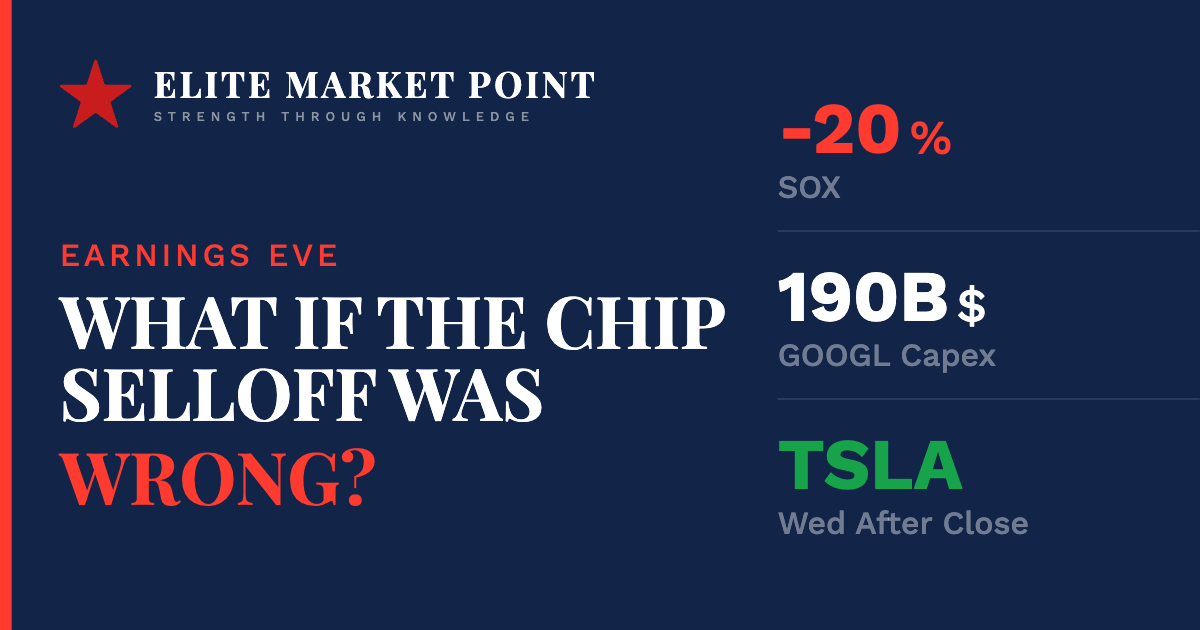
Chips crashed 20%. Tomorrow night, two verdicts.
The semiconductor index just entered a bear market. Alphabet and Tesla report after the close Wednesday. Alphabet’s $190 billion capex guidance is the number that decides whether the chip selloff was a fear trade or the start of something worse. Musk put a date on the robot. That date is tomorrow.
Asia bounced hard overnight. The Kospi surged 4.7%. Samsung jumped 7.4%. The question is whether New York follows or fades it into the print.
Key Idea
The chip index dropped 20% from its June record. That is a bear market. But the companies that caused the run—the ones spending hundreds of billions on AI hardware—have not spoken yet. Alphabet reports tomorrow night. Wall Street expects $101 billion in revenue and watches one line above all others: capital expenditure guidance at $180 to $190 billion. If that number holds, last week was a fear trade. If it shrinks, the fear was early, not wrong. Tesla reports the same night. It delivered a record 480,126 vehicles in Q2. But the real story lands when Musk speaks. He put a specific date on the production-ready Optimus robot reveal. That date is July 22. Tomorrow. Two companies. One night. The chip trade lives or dies on what they say.
Our Partners
At a recent shareholder meeting, Elon Musk did something he almost never does.
He gave a specific date.
July 22.
That’s when Musk says the production-ready version of Tesla’s humanoid robot project, the one he’s called “ten times bigger” than the iPhone, could be unveiled.
That’s when Musk says the production-ready version of Tesla’s humanoid robot project, the one he’s called “ten times bigger” than the iPhone, could be unveiled.
Reveals like this don’t usually come with advance notice.
ChatGPT dropped with zero warning.
The iPhone rumor mill ran for months before anyone had a real date.
This time, the date came from the person building the thing.
That’s rare, and it’s useful.
It means there’s a specific point on the calendar where a quiet story has a real shot at turning into a headline almost overnight.
Matt Monaco, who turned a $2,000 starting stake into more than $3 million trading small, overlooked stocks, has spent weeks tracing the supply chain behind this project.
He found five small companies most investors have never heard of, sitting in the exact spot early iPhone-era suppliers once sat.
Of course all trading is risky, past performance doesn’t guarantee future wins and Matt’s results were exceptional.
But he recently put his full research into a free report.
P.S. Musk doesn’t usually put a specific date on anything. When he does, on something he’s calling the biggest launch of his career, it’s worth five minutes before that date hits.
The Bear Market In Chips
Start with the damage. The Philadelphia Semiconductor Index, the SOX, dropped 20% from its late-June record high. That is a bear market. That is the benchmark that tracks the 30 biggest chip stocks listed in America.
The iShares Semiconductor ETF, SOXX, fell 20.3% from its June 2 peak. The Roundhill Memory ETF, DRAM, cratered 35% from its June 22 high. If you bought the memory trade at the top, more than a third of it is gone.
Now the part the selling ignored. The SOX had surged 105% from its March low to the June peak. Chip earnings are expected to grow 131% this quarter. The fundamentals never cracked. The valuation did. Ed Yardeni, one of the most-followed strategists on Wall Street, warned Monday that semis could fall another 12% to the 200-day moving average. But Barclays and UBS both reiterated buy ratings, with UBS projecting 92% earnings growth this year and 40% next.
Think about that for a second. The sector grew into a bear market while analysts raised their numbers. That is not a fundamental collapse. That is a positioning flush.
The iShares Semiconductor ETF, SOXX, fell 20.3% from its June 2 peak. The Roundhill Memory ETF, DRAM, cratered 35% from its June 22 high. If you bought the memory trade at the top, more than a third of it is gone.
Now the part the selling ignored. The SOX had surged 105% from its March low to the June peak. Chip earnings are expected to grow 131% this quarter. The fundamentals never cracked. The valuation did. Ed Yardeni, one of the most-followed strategists on Wall Street, warned Monday that semis could fall another 12% to the 200-day moving average. But Barclays and UBS both reiterated buy ratings, with UBS projecting 92% earnings growth this year and 40% next.
Think about that for a second. The sector grew into a bear market while analysts raised their numbers. That is not a fundamental collapse. That is a positioning flush.
Tomorrow Night
Two companies report after the close Wednesday. They are not chipmakers. They are chip buyers. That distinction matters more this week than any other week this year.
Alphabet goes first. It is a $4 trillion company and one of the largest purchasers of AI hardware on earth. Wall Street expects $2.87 in earnings per share, up 24% from a year ago. Revenue near $101 billion, up 24%. Google Cloud revenue of $22.8 billion, up 67%. That is the unit that houses most of Alphabet’s AI products.
But the number that decides the chip trade is capital expenditure. Alphabet guided $180 to $190 billion for 2026 and said 2027 would be “significantly” higher. Cloud backlog hit $462 billion last quarter, nearly doubling in three months. If that capex line holds or rises tomorrow night, the chip selloff was a positioning event, not a demand event. If it shrinks, the fear trade was right.
Tesla reports the same evening. Revenue near $27.4 billion. Deliveries already confirmed at 480,126, a quarterly record and 25% above a year ago. The stock closed at $369.57 Monday, down nearly 7% on the week. Tesla has fallen after three of its last four earnings reports. Size it accordingly.
Here is the part most people will miss. Musk confirmed that the production-ready Optimus V3 robot reveal is targeted for late July. Tesla converted its entire Model S and X production line at the Fremont factory to build Optimus. The Q2 earnings call on July 22 is the next hard checkpoint. Musk called this project “ten times bigger than the iPhone.” The robotics trade has a date now. It is tomorrow.
Alphabet goes first. It is a $4 trillion company and one of the largest purchasers of AI hardware on earth. Wall Street expects $2.87 in earnings per share, up 24% from a year ago. Revenue near $101 billion, up 24%. Google Cloud revenue of $22.8 billion, up 67%. That is the unit that houses most of Alphabet’s AI products.
But the number that decides the chip trade is capital expenditure. Alphabet guided $180 to $190 billion for 2026 and said 2027 would be “significantly” higher. Cloud backlog hit $462 billion last quarter, nearly doubling in three months. If that capex line holds or rises tomorrow night, the chip selloff was a positioning event, not a demand event. If it shrinks, the fear trade was right.
Tesla reports the same evening. Revenue near $27.4 billion. Deliveries already confirmed at 480,126, a quarterly record and 25% above a year ago. The stock closed at $369.57 Monday, down nearly 7% on the week. Tesla has fallen after three of its last four earnings reports. Size it accordingly.
Here is the part most people will miss. Musk confirmed that the production-ready Optimus V3 robot reveal is targeted for late July. Tesla converted its entire Model S and X production line at the Fremont factory to build Optimus. The Q2 earnings call on July 22 is the next hard checkpoint. Musk called this project “ten times bigger than the iPhone.” The robotics trade has a date now. It is tomorrow.
Oil, Iran, And The Fed
Oil held near $82 a barrel Tuesday. WTI is up 12% over the past month. Brent crude sits at $88.59. US strikes on Iran entered a tenth consecutive night Monday. Iran struck US targets in Bahrain and Kuwait. The Houthi militants declared a maritime embargo on Saudi Arabia.
Read that again. A maritime embargo on Saudi Arabia. That puts more pressure on Red Sea shipping lanes at the same time the Strait of Hormuz remains contested. Before the war, roughly 110 ships a day transited the Strait. In the past 24 hours, 13 did.
The Fed meets July 28 and 29. The rate sits at 3.50% to 3.75%. No Summary of Economic Projections this time. That is the forecast document and the dot plot. So you get a decision with no map attached. Markets price roughly 90% odds of a hold. Rising oil argues for tighter policy. A 57,000-job June payroll argues for patience. Your gas bill is doing the arguing for you.
Read that again. A maritime embargo on Saudi Arabia. That puts more pressure on Red Sea shipping lanes at the same time the Strait of Hormuz remains contested. Before the war, roughly 110 ships a day transited the Strait. In the past 24 hours, 13 did.
The Fed meets July 28 and 29. The rate sits at 3.50% to 3.75%. No Summary of Economic Projections this time. That is the forecast document and the dot plot. So you get a decision with no map attached. Markets price roughly 90% odds of a hold. Rising oil argues for tighter policy. A 57,000-job June payroll argues for patience. Your gas bill is doing the arguing for you.
The Supply Chain Nobody Is Watching
Everyone is watching the chip stocks. The SOX. Nvidia. The memory names. But the second-order trade from tomorrow night is not in chips. It is in robotics.
Tesla converted its entire Model S and Model X production line at Fremont to build Optimus. That is a 100,000-unit-capacity factory floor now dedicated to a humanoid robot with 10,000 unique parts. Each of those parts has a supplier. Most of those suppliers are small, public, and underfollowed.
When the iPhone launched, the biggest early winners were not Apple. They were the component makers nobody had heard of yet. Musk has put a date on the production-ready reveal. He has committed factory floor space. He has said publicly that Optimus could be worth more than the rest of Tesla combined. If the earnings call confirms a production start, the supply chain reprices before the robot ships a single unit. That is the asymmetry most portfolios are not positioned for.
Tesla converted its entire Model S and Model X production line at Fremont to build Optimus. That is a 100,000-unit-capacity factory floor now dedicated to a humanoid robot with 10,000 unique parts. Each of those parts has a supplier. Most of those suppliers are small, public, and underfollowed.
When the iPhone launched, the biggest early winners were not Apple. They were the component makers nobody had heard of yet. Musk has put a date on the production-ready reveal. He has committed factory floor space. He has said publicly that Optimus could be worth more than the rest of Tesla combined. If the earnings call confirms a production start, the supply chain reprices before the robot ships a single unit. That is the asymmetry most portfolios are not positioned for.
Three Ways Tomorrow Breaks
Base
Alphabet delivers on cloud and holds capex at $180 to $190 billion. The chip selloff steadies. Tesla meets the $27 billion revenue bar and Musk confirms Optimus production has started or will within days. The S&P chops sideways into the Fed. Hold energy (XLE, CVX) as ballast. Keep your highest-conviction AI names. Do not chase the bounce before the print.
Upside
Alphabet raises capex again and beats on cloud. Google Cloud backlog crosses $500 billion. The AI-spend fear reverses. SMH and SOXX bounce 5 to 8% by Friday. Musk unveils Optimus V3 live on the call and announces first commercial shipments. Tesla gaps above $400. Robotics supply-chain names reprice overnight. The Nasdaq retakes 26,000.
Risk
Alphabet trims capex below $180 billion or signals 2027 is no longer a “significant increase.” That confirms the fear. The chip bear market takes a second leg. Yardeni’s 12% further downside call plays out. SMH hits its 200-day. Tesla misses on margins and Musk delays the Optimus reveal again. Oil pushes past $85 and the Fed turns hawkish on the 29th with no dot plot to soften it. Expect a 3 to 5% Nasdaq drop, semis worse. What is different now: the chip bear market is already confirmed. A real capex cut would be the second signal. Two signals are harder to buy back than one.
Our View
We told you Sunday the chip trade split from the broad market. Today you can see it in the numbers. The S&P is down 0.2% from its record. The SOX is down 20%. That is two different markets trading under the same ticker tape.
Here is the part the overnight session just showed you. Asia bounced hard. The Kospi surged 4.7%. Samsung jumped 7.4%. SK Hynix rose 6.4%. The buyers showed up in Seoul before the verdict lands in Mountain View. That tells you sentiment is coiled, not dead.
But do not trade the coil before it releases. Tomorrow night is the release. One line in Alphabet’s report—capital spending—tells you whether $3.3 trillion in semiconductor value was destroyed on a fact or a feeling. And one sentence from Musk on the Optimus production timeline tells you whether the robotics trade has a real catalyst or another delay.
Position around both. Energy and defensives on one side. Your best AI names and cash on the other. Two verdicts. One night. The tape has been guessing for three weeks. Tomorrow it finds out.
Here is the part the overnight session just showed you. Asia bounced hard. The Kospi surged 4.7%. Samsung jumped 7.4%. SK Hynix rose 6.4%. The buyers showed up in Seoul before the verdict lands in Mountain View. That tells you sentiment is coiled, not dead.
But do not trade the coil before it releases. Tomorrow night is the release. One line in Alphabet’s report—capital spending—tells you whether $3.3 trillion in semiconductor value was destroyed on a fact or a feeling. And one sentence from Musk on the Optimus production timeline tells you whether the robotics trade has a real catalyst or another delay.
Position around both. Energy and defensives on one side. Your best AI names and cash on the other. Two verdicts. One night. The tape has been guessing for three weeks. Tomorrow it finds out.